
- Home
- Comparing Alternatives
- Top 6 Constant Contact Alterna ...


Last updated: November 2026
The best Constant Contact alternatives in 2026 are Sendigram for small businesses that want to pay only for the emails they send, AWeber for creators and bloggers, GetResponse for automation and webinars, Klaviyo for e-commerce, Selzy for tight budgets, and MailerLite for simple, affordable newsletters.
Constant Contact has been around since 1995 and, over more than 30 years, has grown from an email tool into a full marketing platform with strong event and social media features. But it isn’t the cheapest option, it has no free plan, and its automation lags behind some newer tools.
So what are the best Constant Contact alternatives in 2026? In this article, we compare Constant Contact with our own platform, Sendigram, and five other popular options, old and new: AWeber, GetResponse, Klaviyo, Selzy, and MailerLite. We can’t cover every pro and con, but we highlight each tool’s biggest strengths and weaknesses, along with current pricing.
Start with the key takeaways in the table below, then read on for the details. Prices are as of October 2026 and change often, so check each provider’s pricing page before you buy.
| Platform | Free plan | Paid plans from | Support | Best for |
|---|---|---|---|---|
| Constant Contact | No (free trial) | $12/mo (Lite, 500 contacts) | Phone, chat, email | Event marketing, social media, beginners |
| Sendigram | 10,000 free emails to start | $6/mo (SendiStart, 5,000 emails) | Free expert support and live onboarding | Small businesses without a marketing team |
| AWeber | 500 subscribers, 500 emails/mo | $15/mo ($12.50 billed annually) | Email and chat; priority 24/7 support on Plus | Creators, bloggers, small businesses |
| GetResponse | 500 contacts, 2,500 emails/mo | $19/mo (Starter, 1,000 contacts) | 24/7 chat and email; phone on higher tiers | Advanced automation, webinars, online businesses |
| Klaviyo | 250 profiles, 500 emails/mo | $20/mo (Email plan) | Email and chat on paid plans | E-commerce brands |
| Selzy | 100 contacts, 1,000 emails/mo | $5.25/mo (Lite, billed annually) | 24/7 chat, email, phone on all plans | Startups and SMBs on a budget |
| MailerLite | 250 subscribers, 2,500 emails/mo | $12/mo (Comfort, 500 subscribers) | Email; live chat on Power plan | Freelancers, bloggers, small businesses |
All of these alternatives now include AI tools for writing emails and subject lines, so that’s no longer a key differentiator.
In this article:
- Constant Contact at a glance
- How we chose these alternatives
- 1. Sendigram
- 2. AWeber
- 3. GetResponse
- 4. Klaviyo
- 5. Selzy
- 6. MailerLite
- Frequently asked questions
- To sum up
Constant Contact at a Glance
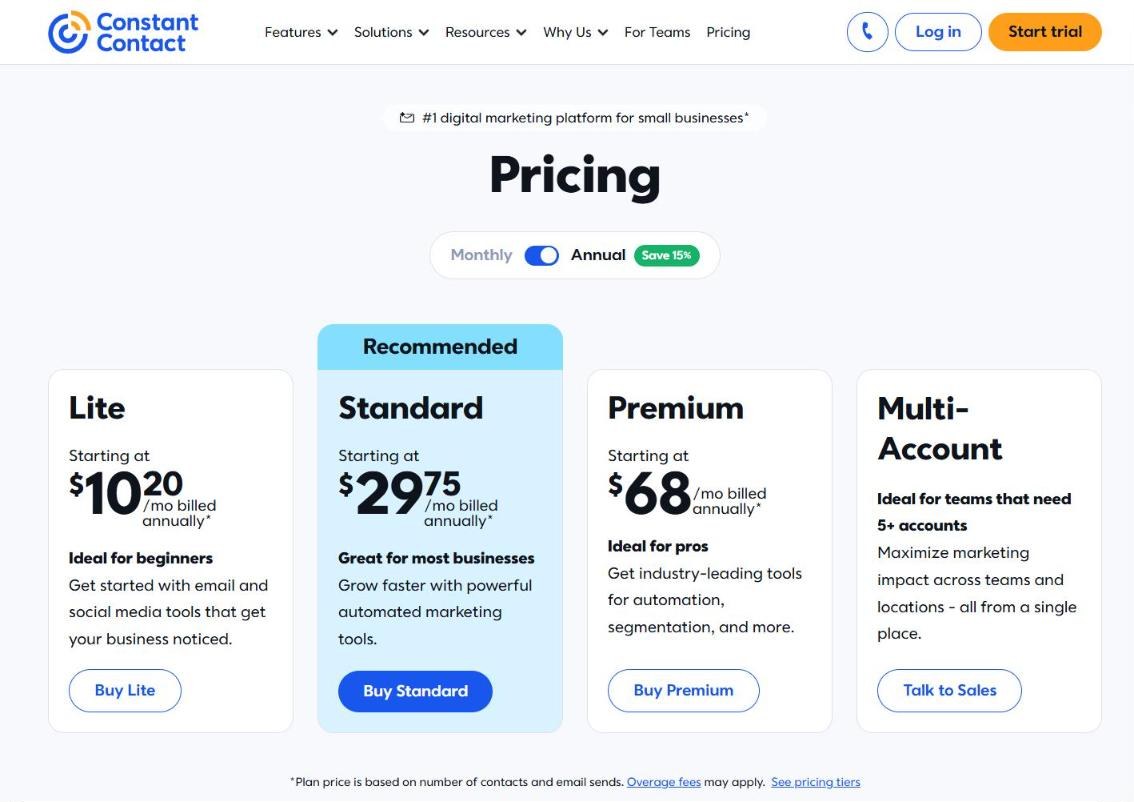
Constant Contact offers three plans, Lite, Standard, and Premium, priced by number of contacts: about $12, $35, and $80 per month for 500 contacts, rising to about $120, $160, and $275 per month for 10,000 contacts. There’s no free plan, but you can try it with a free trial that doesn’t require a credit card.
Pros:
- Beginner-friendly and easy to set up
- Strong event management and social media tools
- Phone, chat, and email support on all plans
- Wide range of integrations
Cons:
- No free plan
- Gets expensive as your list grows
- Automation is less advanced than many competitors’
- Templates can feel dated
These drawbacks, mainly price and automation, are the most common reasons businesses look for alternatives. Here’s how the top alternatives compare.
How We Chose These Alternatives
We compared each platform with Constant Contact on five criteria: pricing and free-plan limits, ease of use, automation, integrations, and customer support. Prices come from each provider’s official pricing page, as of October 2026. Sendigram is our own product, so we review it against the same criteria and list its drawbacks too.
1. Sendigram
Full disclosure: Sendigram is our own product. We’ve aimed to keep this comparison fair, including where Sendigram falls short.

Features
Sendigram is an email marketing platform built for small businesses that want to run email marketing without a dedicated team: no email marketer, copywriter, or designer needed. Its AI Email Builder turns a short prompt into a ready-to-edit email with copy, images, and layout, and the Sendigram AI Assistant lets you create emails, campaigns, automations, and segments through a simple chat.
Deliverability is a core focus. Sendigram validates your contacts and checks every campaign and automation before it goes out to protect your sender reputation. You also get 400+ templates, a drag-and-drop editor with HTML import, ready-made automation workflows, and a campaign calendar for planning around holidays and key dates.
Compared with Constant Contact, Sendigram has fewer event and social media marketing tools, but offers more built-in AI help and stronger pre-send deliverability checks.
Pricing plans
Sendigram’s pricing works differently from most platforms: you pay for the emails you send, not the contacts you store, and you can keep unlimited contacts at no extra cost. You can start with 10,000 free emails, no credit card required. Paid plans start at $16 per month for 20,000 emails on the SendiStart plan, with SendiPro ($20) and SendiMax ($25) adding more AI credits and users. Annual billing saves 15%.
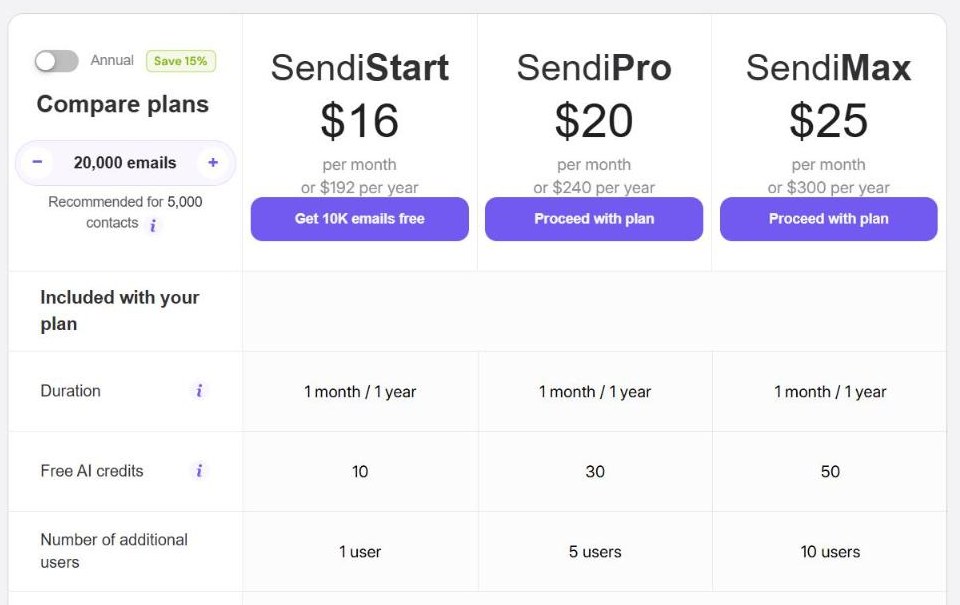
Constant Contact, by contrast, charges by the number of contacts, so your bill grows with your list even if you rarely email it. That makes Sendigram especially cost-effective for businesses with large lists that send less often.
User interface and ease of use
Sendigram is designed for non-experts. An interactive onboarding flow walks you through setup, from connecting your sender domain to launching your first campaign, in about 10 minutes. Goal-based templates and step-by-step guidance make it as beginner-friendly as Constant Contact, if not more so.
Integration capabilities
Sendigram connects with custom websites, WordPress, and Shopify to sync contacts and activity for segmentation and automated emails, with WooCommerce, OpenAI Codex, and Claude Code integrations coming soon. Its integration library is still much smaller than Constant Contact’s, so check that the tools you rely on are supported.
Customer support and resources
Sendigram includes free expert support from your first demo through to migration, plus live onboarding help inside the app, and you can book a personalized live demo. Constant Contact offers phone, chat, and email support on all plans.
Business sectors
Sendigram is a great fit for small businesses, solopreneurs, and online stores that want professional email marketing without hiring specialists. It’s especially good value if you have a large contact list but send campaigns occasionally.
2. AWeber
Features
AWeber is a Constant Contact alternative with advanced email automation tools, drag-and-drop builder, and behavioral automation. Besides, the company is considered to be the inventor of the autoresponder function.
AWeber is focused primarily on email functions, so it offers less overall functionality than some other platforms. However, its email-related features, like A/B testing, autoresponder follow-ups, and segmented subscriber lists based on user actions, are its strong side.
Constant Contact, on the other hand, decided to diversify and evolve beyond just email marketing. What sets it apart from other platforms is its event management tools and social media campaign capabilities.
Both platforms provide a variety of email templates and a built-in image library. AWeber templates are modern, responsive, and plentiful too. However, while some templates are available on the AWeber free plan, Constant Contact is missing this option due to a different pricing policy.
Pricing plans
AWeber offers a free plan for up to 500 subscribers and 500 emails per month, which makes it a good starting point for new businesses on a tight budget. Paid plans start at $15 per month ($12.50 per month billed annually) on the Lite plan, with the Plus plan at $20 per month billed annually. Prices rise with your number of subscribers (AWeber pricing).
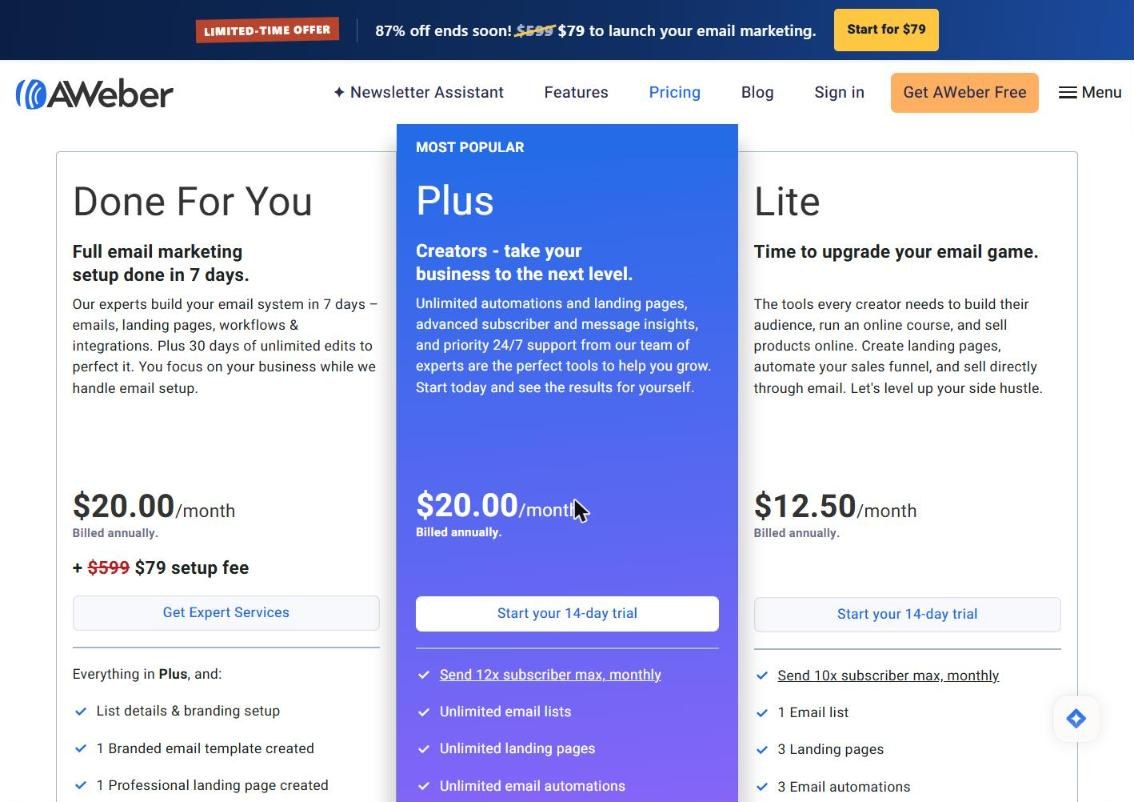
Constant Contact has no free plan, and its Lite plan starts at $12 per month for up to 500 contacts with fairly limited functionality. As with AWeber, prices rise with your number of contacts and with the features you need, such as advanced automation and segmentation (Constant Contact pricing).
User interface and ease of use
AWeber has an intuitive and clean interface. It allows users to quickly grasp the full functionality of the tool without a steep learning curve. The drag-and-drop email builder and the ability to easily create automated campaigns make it an attractive option.
One quirk: its features are listed under the Menu tab rather than a Features section, which can be slightly confusing at first, though it doesn’t get in the way of everyday use.
Constant Contact also has a user-friendly interface that smoothly guides users from account setup to campaign execution. Its design prioritizes simplicity and efficiency, making it a similar alternative to AWeber in this regard.
Integration capabilities
AWeber integrates with hundreds of apps, which makes it a strong Constant Contact competitor here. It covers all the essentials, like WordPress, Shopify, and PayPal, but may lack some of the more specialized integrations available with Constant Contact.
Customer support and resources
Constant Contact provides excellent customer support with multiple channels, including phone, email, and live chat. Support is available during extensive business hours to accommodate a wide range of time zones and includes access to a comprehensive knowledge base and community forums. Users on all plans can access its support and resources.
AWeber also offers strong support, though options vary by plan. While all plans include email and chat support, phone support is not available on a free plan. Higher tiers add extras such as a dedicated account manager. Users note the quality of AWeber support across all mediums, as well as its extensive knowledge base.
Business sectors
While Constant Contact is particularly advantageous for businesses engaged in direct event marketing or those that utilize social media campaigns, AWeber, on the other hand, is suitable for a broad range of businesses. It’s particularly popular with small to medium-sized enterprises or solopreneurs. It is used by YouTubers, bloggers, and small e-commerce shops alike.
3. GetResponse
Features
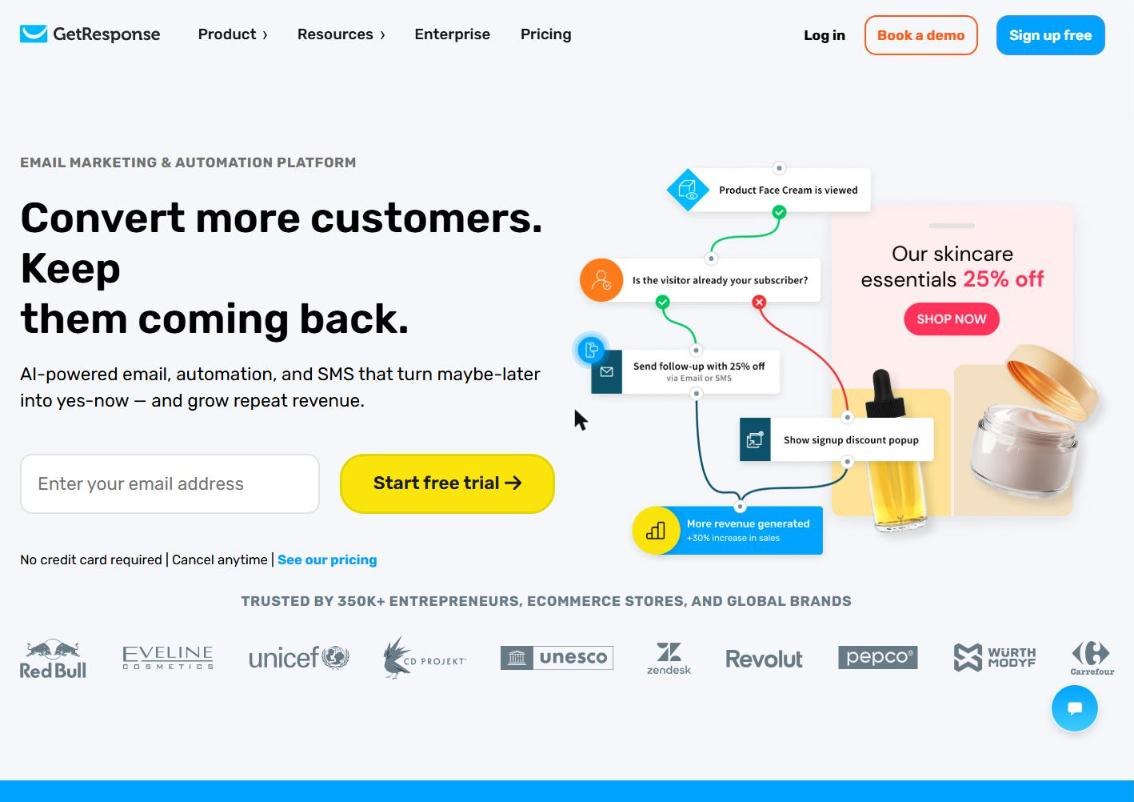
GetResponse stands out with its straightforward email and newsletter builder that guides users through the design process on a single page. Its templates are better than many competitors’ and can be easily customized or created from scratch, including options to design in HTML.
Its automation is both advanced and user-friendly compared with many alternatives, and built-in AI tools help you generate emails and subject lines.
GetResponse also includes a lesser-known but effective website builder, offering easily customizable templates through a code-free editor.
Constant Contact’s automation is less advanced overall and does not offer a multi-channel option. Similarly, its template library, while being rather extensive, might benefit from being updated with more modern and better-looking templates.
GetResponse may beat Constant Contact on automation and templates, but that doesn’t make it better across the board. The two platforms prioritize different things, so each suits a different audience.
Pricing plans
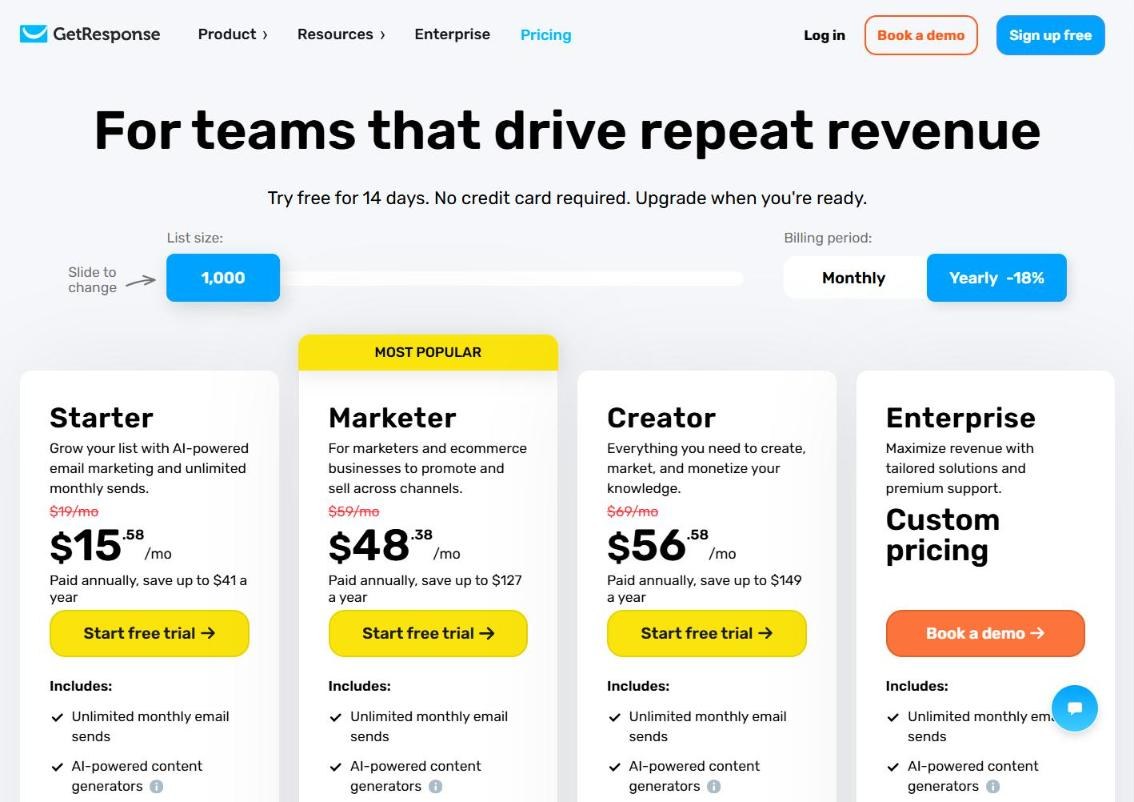
GetResponse is generally the more affordable option. Its Starter plan costs $19 per month for 1,000 contacts ($15.58 per month billed annually) and includes unlimited email sends, while Constant Contact’s Lite plan already costs about $50 per month at 2,500 contacts (GetResponse pricing).
GetResponse also has a free-forever plan for up to 500 contacts and 2,500 emails per month, which Constant Contact doesn’t offer. It’s limited, but it’s a good way to test the platform.
GetResponse’s higher tiers (Marketer, Creator, and MAX) add more advanced automation, integrations, and other useful features.
User interface and ease of use
GetResponse gets overall positive feedback on its user interface, with users calling it user-friendly and easy to use. While it might have a slightly steeper learning curve due to its more advanced features, once familiar, users can efficiently manage complex campaigns, automate workflows, and analyze detailed reports.
Constant Contact is also praised for its user-friendly interface that is straightforward to navigate, making it ideal for beginners and those who prefer simplicity in their marketing tools.
Integration capabilities
GetResponse integrates with e-commerce, CRM, social media, and CMS apps, though some users find its library smaller than those of other platforms.
Still, GetResponse offers integrations with e-commerce platforms like Shopify and BigCommerce, CRMs like Salesforce, and other popular tools like WordPress and Slack.
Customer support and resources
GetResponse provides robust support with 24/7 live chat and email, ensuring users can get help whenever needed. The platform also provides a comprehensive help center, including video tutorials, webinars, and a rich blog full of marketing tips and strategies. Phone support is limited to higher-tier plans, but users rate it highly.
Here the two platforms are evenly matched, with Constant Contact similarly praised for the quality of its support.
Business sectors
GetResponse can serve both small businesses and larger enterprises that require sophisticated marketing automation and good e-commerce functionality. It’s a strong choice for online businesses, digital marketers, and companies that host webinars as part of their marketing strategy.
4. Klaviyo
Features
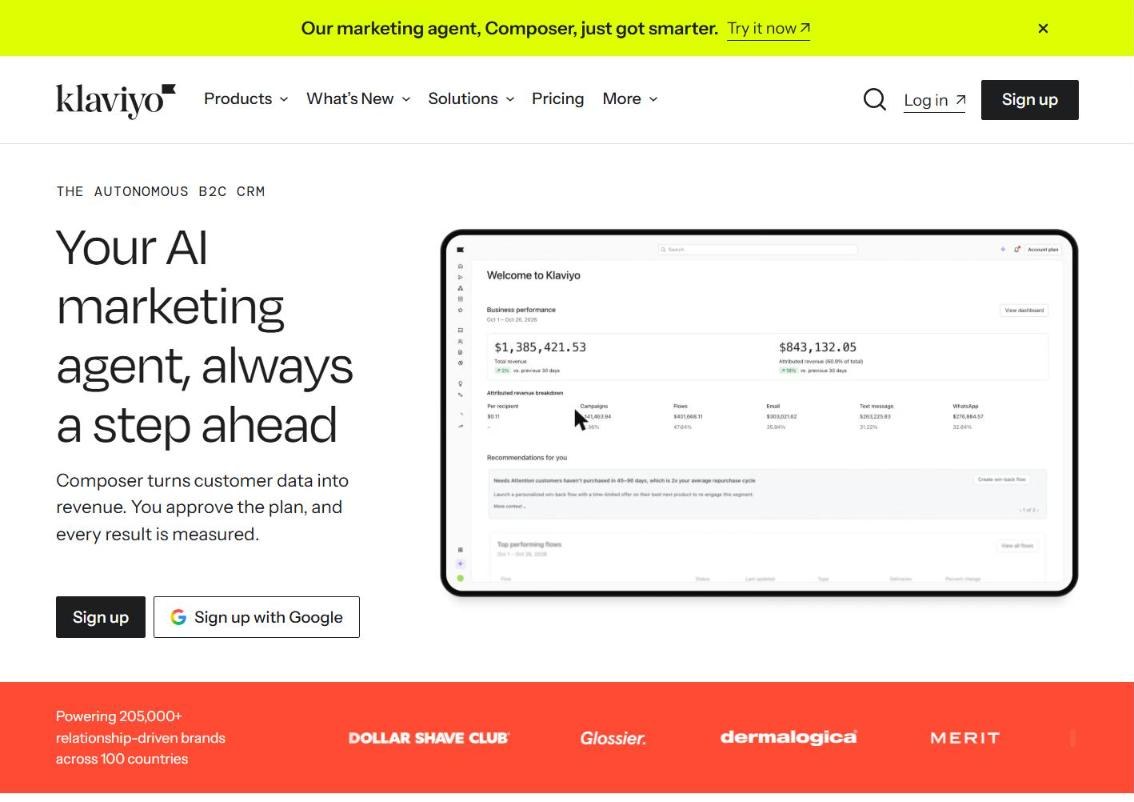
Klaviyo covers the essentials, like automation, analytics, and integrations, but what makes it one of the best Constant Contact alternatives is its segmentation capabilities. Klaviyo offers a particularly advanced segmentation option with various metrics to shape it for your target audience.
Klaviyo’s automation and analytic tools are also more advanced in comparison to Constant Contact. However, a steeper learning curve is the price you’ll have to pay to reap those benefits offered by Klaviyo.
Klaviyo has also grown well beyond email. It now includes SMS, built-in AI tools, and customer data features, and positions itself as a full CRM for consumer brands.
Pricing plans
Klaviyo’s pricing scales with your number of contacts (profiles). Its free plan covers 250 active profiles and 500 email sends per month, and the paid Email plan starts at $20 per month. Costs can climb significantly as your list grows, which is worth considering for larger operations and fast-growing small businesses alike (Klaviyo pricing).
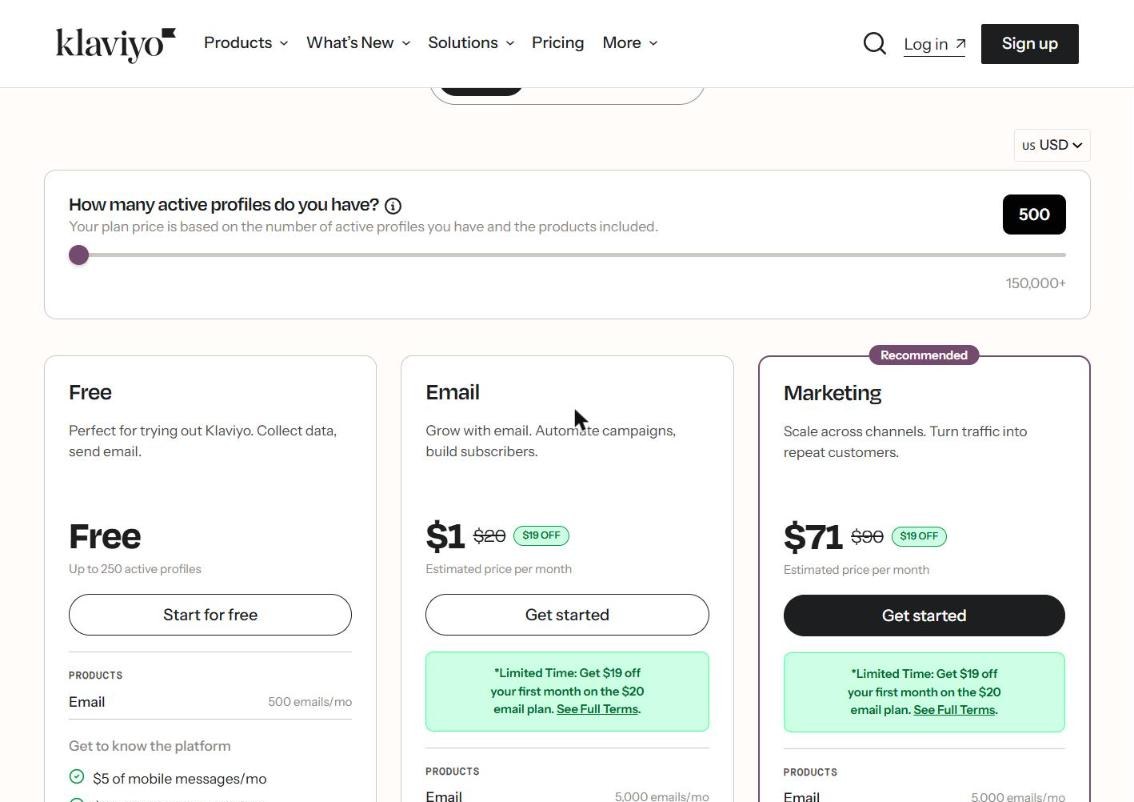
While Constant Contact also operates on a scale-based pricing model, it does not offer a free plan. You can test it with a free trial instead.
User interface and ease of use
While Klaviyo definitely looks like a very professional and well-organized platform with advanced features, some users consider it steering toward more professional marketers that have a good grasp of advanced marketing automation and segmentation techniques.
While the platform takes some time to learn, it offers support to its users in the form of case studies, help centers, and even interactive workshops.
So if you are a beginner and not ready to go into the depths of advanced marketing, you might consider other options to choose from.
While having a user-friendly interface, Constant Contact is designed to help users quickly set up and execute email marketing campaigns without prior experience. This is a better platform for beginners and smaller companies with less advanced needs.
Integration capabilities
Klaviyo offers 400+ integrations, particularly with e-commerce platforms, including Shopify, Magento, and WooCommerce. Klaviyo’s integrations are designed to leverage real-time data from these platforms to enable powerful segmentation and personalization features.
Constant Contact integrates with a wider range of platforms, allowing for wider diversification but providing overall less advanced data leverage across platforms.
Customer support and resources
Constant Contact provides excellent customer support, with options including live chat and phone support across all plans.
Klaviyo offers no phone support, while email and chat support are available for its paid plans. The free plan has email support for the first 60 days. Considering that Klaviyo is targeting businesses with more advanced marketing needs, its customer support might have been more advanced and diverse.
That said, Klaviyo places a strong emphasis on education, providing users with extensive documentation, training webinars, and a community of users.
Business sectors
Like Constant Contact, Klaviyo is well-tailored to a wide range of businesses of all sizes, especially to e-commerce and retail marketing. Considering that the platform is rather advanced, it might not fit solopreneurs or bloggers, which might require more straightforward options.
5. Selzy
Features
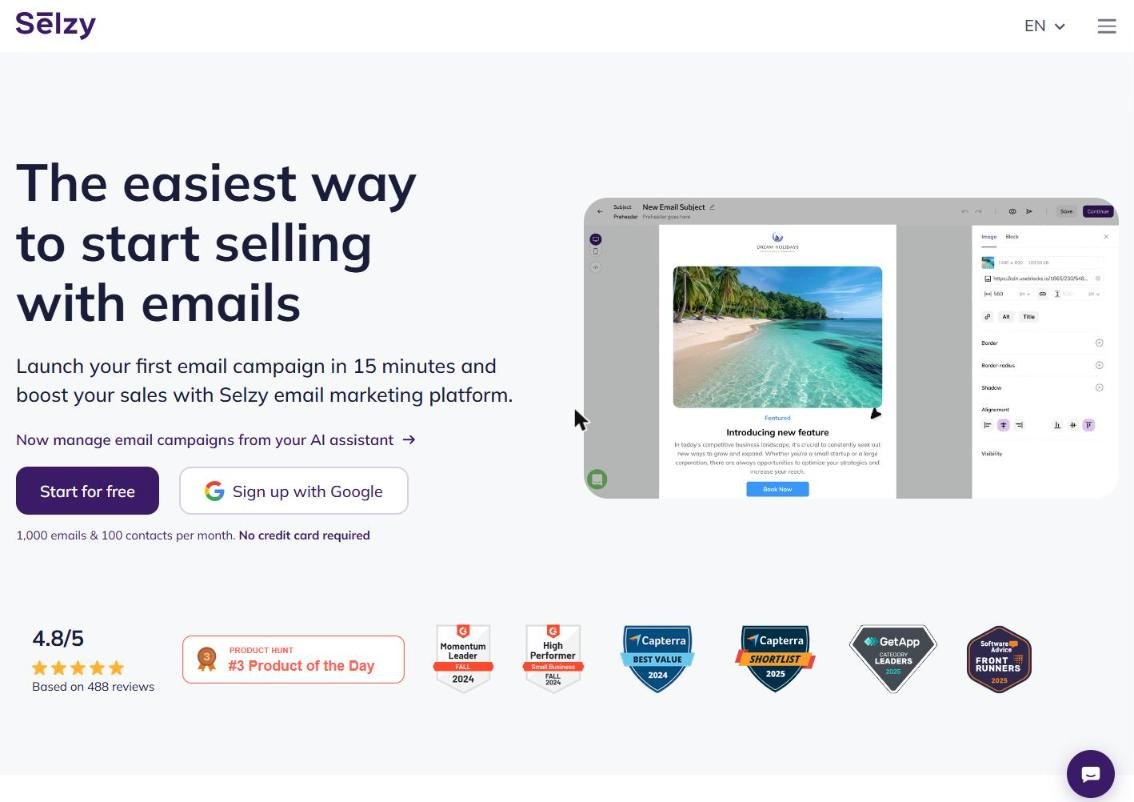
Selzy is a newer platform that focuses on making the overall email marketing experience both pleasant and effective for its users. It provides advanced automation tools with more than 12 different pre-designed templates. Its segmentation also comes out as strong, with 70+ criteria for customer segmentation.
Being focused on email deliverability, Selzy encourages A/B testing as well as provides drag-and-drop templates, supported by a built-in media gallery and AI tools.
In comparison to Constant Contact, the platform seems to have fewer email templates, which is sometimes observed by users.
Pricing plans
Selzy’s pricing is flexible and affordable. Its free plan lets you send up to 1,000 emails a month to 100 contacts (with a Selzy logo in the footer). Paid plans scale with your list size, starting from $5.25 per month on the Lite plan (billed annually, with a current 30% discount), and higher tiers add extras such as a full campaign management service (Selzy pricing).
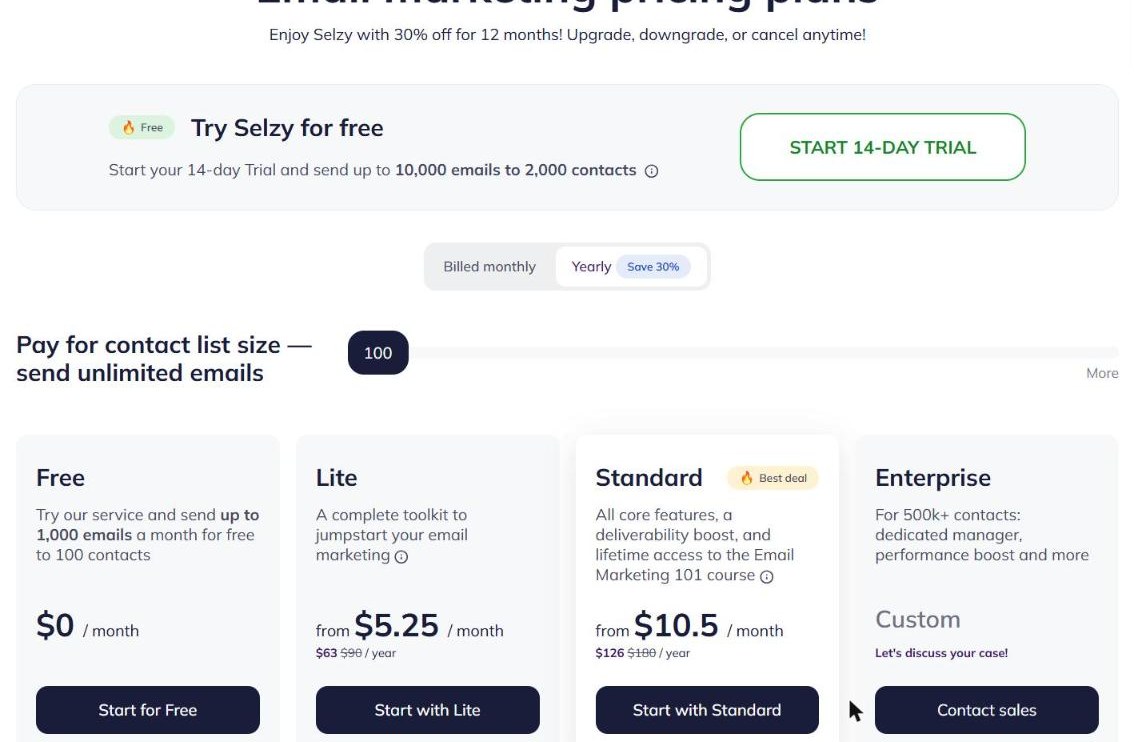
Constant Contact’s pricing is less flexible by comparison. It has no free plan, and at 10,000 contacts its Standard plan costs about $160 per month. Selzy typically costs considerably less for the same list size, so use its pricing calculator to compare.
So if you’re looking for a low-cost Constant Contact alternative, Selzy is worth a look.
User interface and ease of use
Selzy’s platform is designed to be user-friendly, especially for those who are less experienced in email marketing, offering guided workflows and smart recommendations to enhance user engagement. Selzy features a modern interface that is considered to be “friendly,” “intuitive,” and even “the best.”
Constant Contact, similarly, is also considered to be a user-friendly platform, easy to navigate and manage email campaigns with minimal technical knowledge.
Neither of the platforms requires a steep learning curve to start creating great email campaigns.
Integration capabilities
Selzy’s integration library is fairly small, which may be a limiting factor. It does connect with WordPress, Shopify, HubSpot, and other major services, but it’s still more limited than most other platforms, including Constant Contact.
Customer support and resources
Both platforms are equally helpful when it comes to their customer support.
Selzy offers 24/7 support on all plans, including the free one, via chat, email, and phone in six languages. Constant Contact helps its users via email, phone, and chat during extended working hours and is also highly valued by users.
Business sectors
With its easy-to-use marketing approach, Selzy targets small and medium-sized companies from different sectors, as well as startups that prioritize innovation and efficiency in their marketing strategies. Considering the included automation builder and some other useful features, it seems like an attractive offer.
6. MailerLite
Features
MailerLite is one of the newer alternatives to Constant Contact. Email automation is easy to use and has an auto-resend option; however, some users find it a bit too simple in comparison with other platforms.
Its segmentation, on the other hand, is quite advanced, letting you apply different conditions and filters to your subscribers.
MailerLite has a large choice of email templates, while their drag-and-drop design requires no special knowledge to build an email. It is also supplemented with a plain text editor and HTML editor.
Analytics are not MailerLite’s strongest side, as its reporting is fairly basic.
Pricing plans
When it comes to pricing, MailerLite is still one of the most affordable options, although it has cut back its free plan, which now covers up to 250 subscribers and 2,500 emails per month (MailerLite pricing).
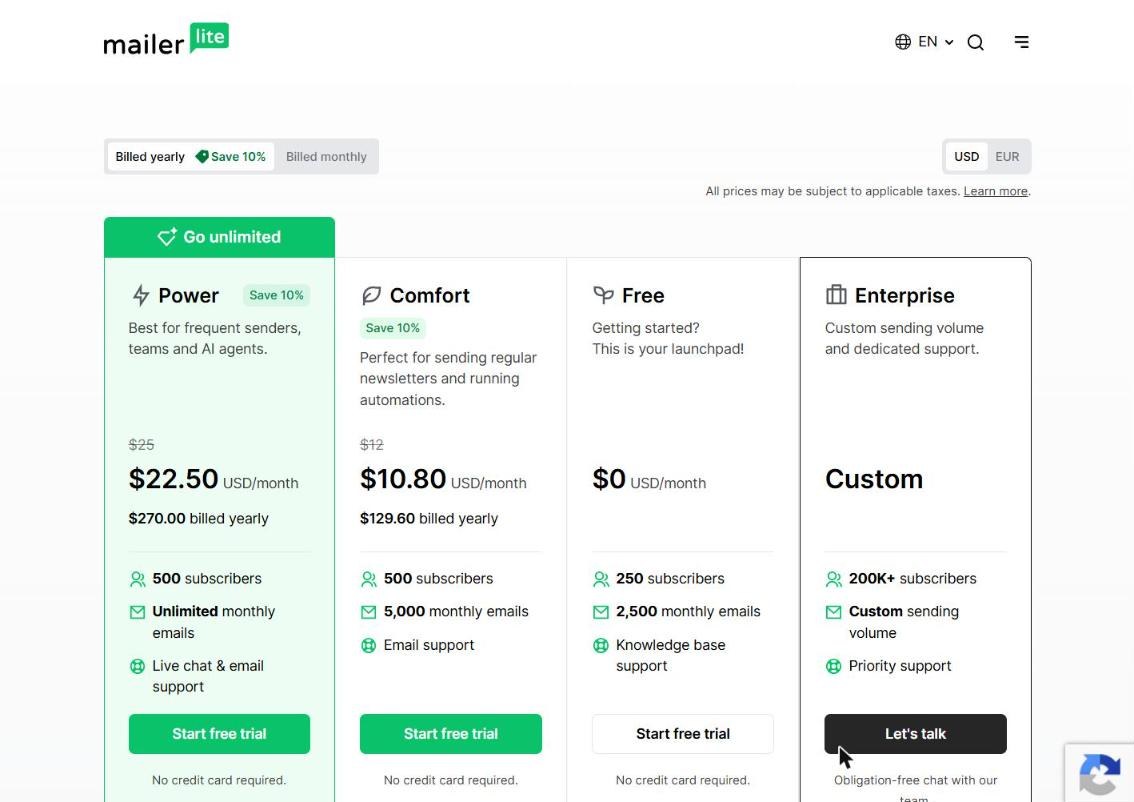
Its paid plans are also very reasonably priced. The Comfort plan starts at $12 per month for 500 subscribers and costs about $89 per month for 10,000 subscribers, while the Power plan adds advanced features from $25 per month. For 10,000 contacts, Constant Contact costs about $120–$275 per month depending on the plan, and it has no free plan.
User interface and ease of use
Both platforms are considered to have very user-friendly interfaces. Nonetheless, MailerLite, being a platform for small businesses and beginners, takes it to the next level. It makes the process of email creation simple and intuitive, both for professionals and beginners.
Integration capabilities
MailerLite offers a solid range of integrations, including diverse tools for videos, e-commerce, event planning, project management, and others. Besides, its integration with Stripe allows you to sell products and services right on your landing page.
If there’s a tool that you miss, MailerLite still allows you to connect with it by using their API.
Constant Contact’s integration list is more diverse and offers more tools for those specializing in event marketing.
Customer support and resources
MailerLite offers email support on its Comfort plan and live chat plus email support on its Power plan, and users rate it highly.
Constant Contact adds phone support on top of two other options and does so similarly well.
Business sectors
Being very reasonably priced, this platform is great for small companies, freelancers, or individual entrepreneurs. It will also be a good option for bloggers since it offers features like video marketing and RSS campaigns.
Frequently Asked Questions
What is the cheapest Constant Contact alternative?
It depends on how you use email. If you have a large list but send occasionally, Sendigram is often cheapest because it charges for emails sent rather than contacts stored. Otherwise, MailerLite and Selzy are usually the most affordable. Both have free plans and low-cost paid tiers, and both stay cheaper than Constant Contact as your list grows.
Which Constant Contact alternative is best for e-commerce?
Klaviyo is the strongest choice for online stores thanks to its deep Shopify and WooCommerce integrations and advanced segmentation. GetResponse is a good all-round alternative.
Does Constant Contact have a free plan?
No. Constant Contact offers a free trial, but no free-forever plan. AWeber, GetResponse, Klaviyo, Selzy, and MailerLite all have free plans, and Sendigram gives you 10,000 free emails to start.
Which alternative is best for beginners?
Sendigram, MailerLite, and Selzy are the easiest to learn; Sendigram even walks you through setup with interactive onboarding. AWeber is also very approachable, while Klaviyo has the steepest learning curve.
To Sum Up
Each of these platforms is like Constant Contact in some ways and different in others, and there’s no single “best” tool. The right choice depends on your needs:
- Sendigram: best for small businesses that want AI-assisted email marketing without a dedicated team, and pay only for the emails they send.
- AWeber: best for creators and small businesses focused purely on email.
- GetResponse: best for advanced automation, webinars, and online businesses.
- Klaviyo: best for e-commerce brands that need deep segmentation.
- Selzy: best for startups and SMBs that want strong support on a budget.
- MailerLite: best for freelancers and bloggers who want simplicity at a low price.
Most of these tools offer a free plan or trial, so test two or three before you commit. Want to see how Sendigram compares for yourself? Start with 10,000 free emails, no credit card required.
Comparing other tools? See our guides to Mailchimp alternatives, MailerLite alternatives, and ActiveCampaign alternatives.


 Your Privacy Choices
