
- Home
- Fundamentals of Email Marketing
- Are Post-Purchase Emails Trans ...


Post-purchase emails are usually transactional when their main purpose is to provide information about an existing order. However, adding product recommendations, discounts, upsells, or other promotional content may cause the message to be treated as marketing.
The exact legal test depends on the recipient’s country. The safest practical approach is to keep essential order information prominent, separate promotional campaigns when possible, and obtain appropriate permission before adding marketing.
This article provides general information, not legal advice.
What is a post-purchase email?
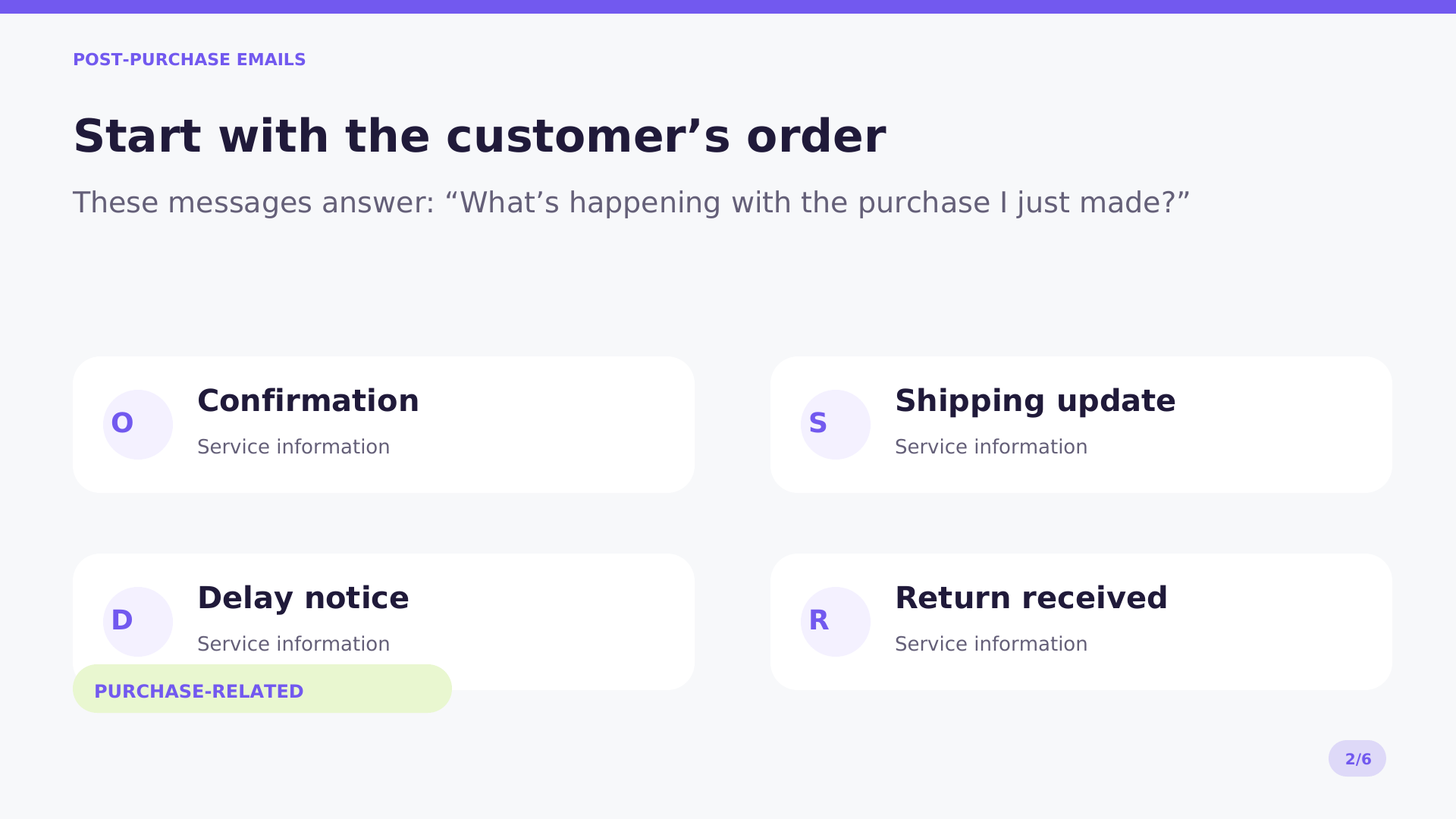
A post-purchase email is triggered after a customer places an order or completes another transaction. Common examples include:
- Order confirmations
- Payment receipts
- Shipping updates
- Delivery-delay notices
- Return confirmations
- Refund updates
- Backorder notifications
These messages answer an immediate customer question:
What is happening with the purchase I just made?
When an email simply communicates necessary information about that transaction, it is generally treated as a service or transactional message.
Does an order trigger automatically make an email transactional?
No. The trigger does not determine the legal category by itself.
An email sent after a purchase can still contain marketing. For example, an order confirmation might include:
- Recommended products
- A discount on the next purchase
- A referral offer
- A loyalty-program promotion
- A large banner advertising another product
- An invitation to shop a new collection
Whether that changes the message’s classification depends on the applicable law and how the promotional content is presented.
How does the United States classify mixed post-purchase emails?
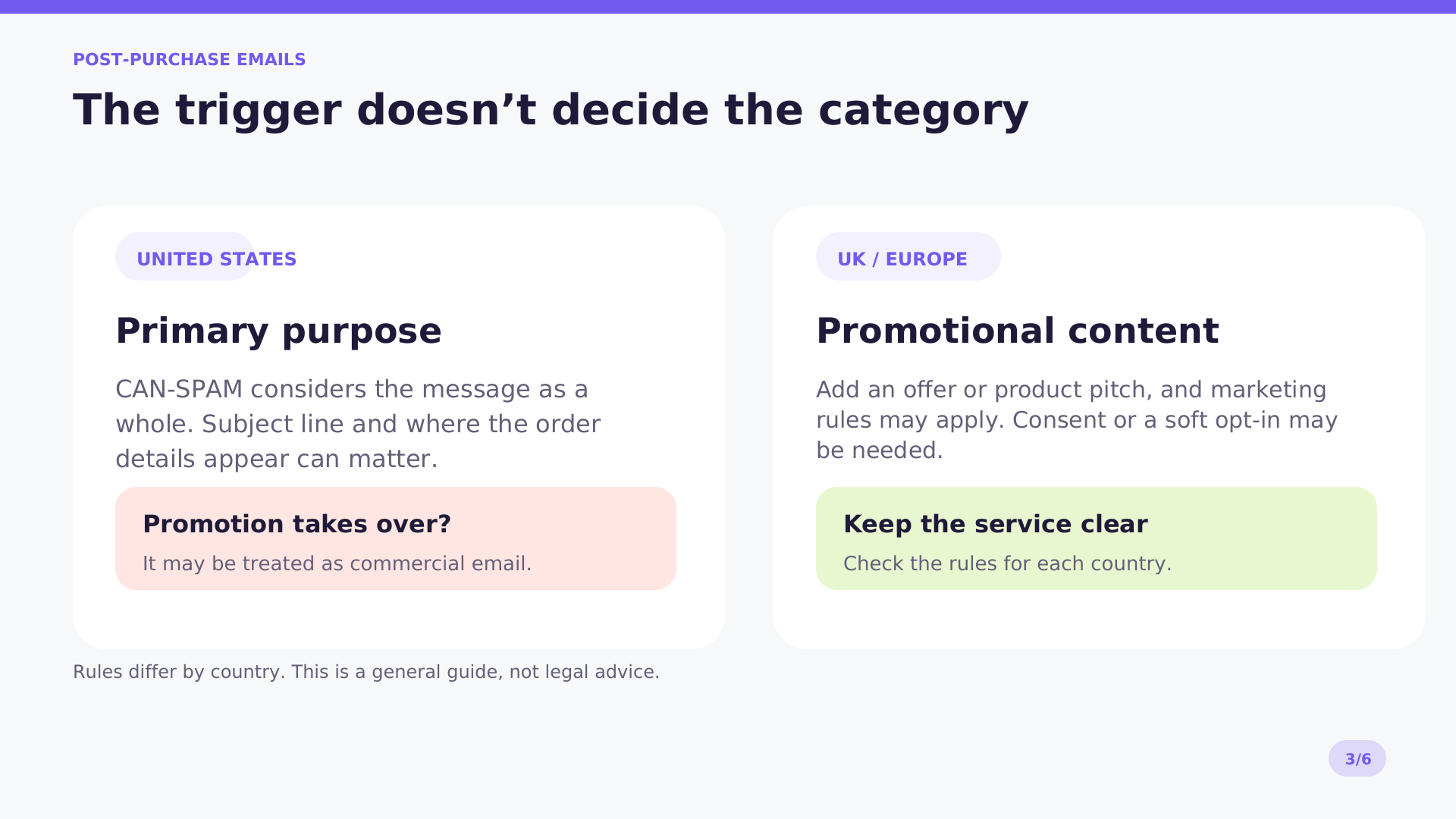
Under the US CAN-SPAM framework, the message’s primary purpose matters.
The Federal Trade Commission distinguishes commercial content from transactional or relationship content. If an email combines both, factors such as the subject line and the placement of the transactional information help determine its primary purpose.
A mixed email may be considered commercial if:
- The subject line makes the recipient expect a promotion.
- The transactional information does not appear mainly at the beginning.
- Advertising dominates the design or content.
- A reasonable recipient would interpret the message primarily as an advertisement.
A clear subject line such as “Your order has shipped” supports a service purpose. A subject line such as “Your order has shipped—plus 30% off your next purchase” introduces a promotional purpose immediately.
The FTC also interprets the transactional category narrowly. An existing customer relationship does not automatically make every message transactional. (Source: Federal Trade Commission)
How are service emails treated in the UK?
UK guidance draws a firmer line between service information and marketing.
A message sent solely for administrative or customer-service purposes is not direct marketing. However, adding advertising or promotional content can turn it into direct marketing—even when promotion is not the email’s main purpose. General branding and logos alone do not normally create that problem. (Source: ico.org.uk)
For unsolicited marketing emails sent to individual subscribers, an organization generally needs consent or must satisfy all the conditions of the soft opt-in. The UK soft opt-in requires, among other things, that:
- The address was collected directly from the person.
- It was collected during a sale or genuine sales negotiation.
- Marketing concerns the sender’s own similar products or services.
- An opt-out was offered when the address was collected.
- A simple opt-out appears in every later marketing message.
Different rules may apply to corporate subscribers. (Source: ico.org.uk)
What is the position in the EU?
The EU ePrivacy Directive generally requires prior consent for email sent for direct-marketing purposes.
It includes an exception for an existing customer relationship when a business promotes its own similar products or services. To use this exception, customers must receive a clear, easy, and free opportunity to object both when their details are collected and in every subsequent message.
Member states implement these requirements through national law, so businesses should check the rules in each country where they operate. (Source: EUR-Lex)
Should promotional content be included in transactional emails?
It can be, where permitted, but that does not mean it should dominate the message.
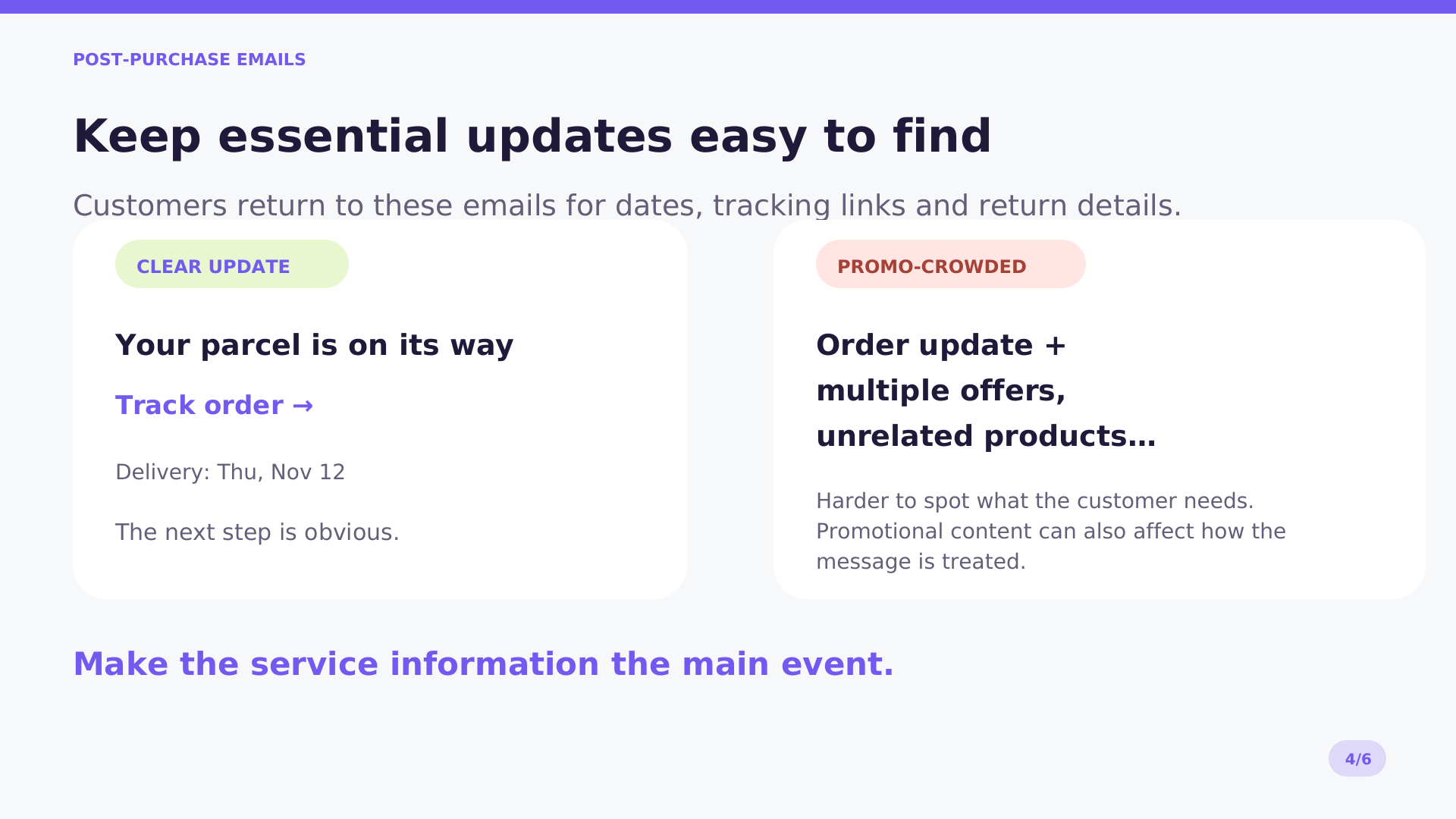
Customers return to post-purchase emails to find:
- Delivery dates
- Tracking links
- Order numbers
- Return instructions
- Payment details
- Support information
If an email forces them to scroll past several offers to find a tracking link, it is failing at its primary job.
A better structure is:
- State the order status clearly.
- Show the important details.
- Provide the next action.
- Explain delays or exceptions.
- Place any permitted secondary content after the service information.
Essential information should remain the main event.
Can promotions affect transactional email deliverability?
Legal classification and mailbox filtering are separate questions.
Even if your legal team considers a message transactional, recipients may still report it as spam if it feels promotional or irrelevant. Gmail states that high spam rates can affect delivery across message types, while its one-click unsubscribe requirement applies to marketing and promotional messages rather than transactional messages. (Source: Gmail Help)
This creates a practical reason to separate service and marketing traffic:
- Customers can receive necessary order updates without promotional clutter.
- Promotional preferences can be managed independently.
- Complaints against marketing messages are less likely to interfere with critical notifications.
- Teams can monitor the two streams separately.
- The purpose of each message remains clearer.
Where possible, consider using different sending addresses or streams for subscription marketing and essential transactional emails. Gmail recommends separating subscription and non-subscription messages, with receipts and password resets given as examples of non-subscription email. (Source: Gmail Help)
Who should own post-purchase emails?
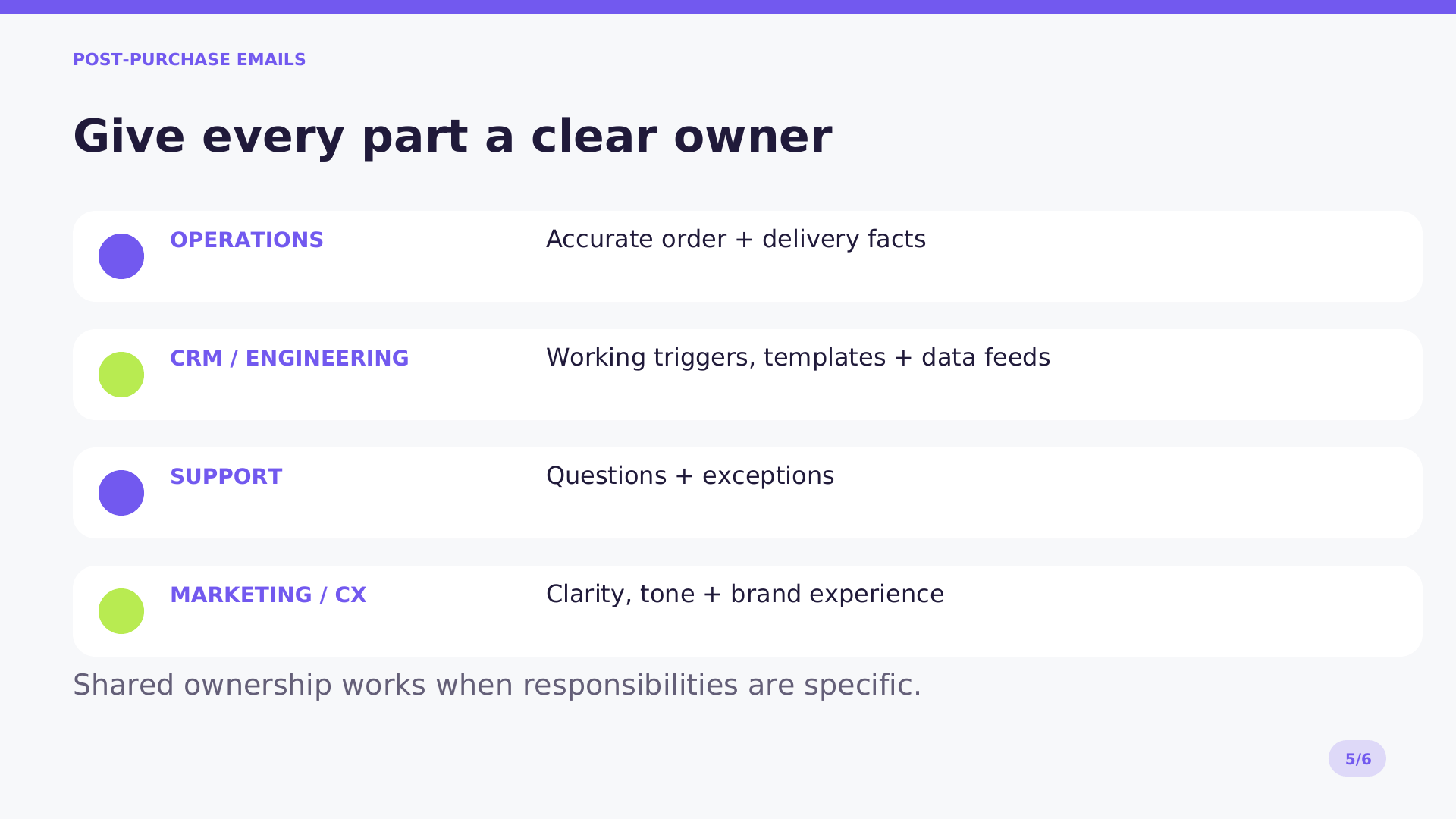
Post-purchase email is rarely the responsibility of one department.
Operations
Operations should own the accuracy of:
- Order information
- Inventory status
- Delivery estimates
- Return status
- Delay explanations
CRM and engineering
Technical teams should ensure:
- Triggers work correctly
- Customer data is accurate
- Templates display properly
- Tracking links work
- Failed messages are identified
- Data feeds remain synchronized
Customer support
Support teams should contribute:
- Frequently asked questions
- Clear escalation routes
- Exception handling
- Contact information
- Explanations for common delays
Marketing and customer experience
Marketing or CX teams can improve:
- Clarity
- Tone
- Accessibility
- Visual hierarchy
- Brand consistency
- The overall customer experience
Shared ownership works only when every responsibility has a clear owner.
How should post-purchase email performance be measured?
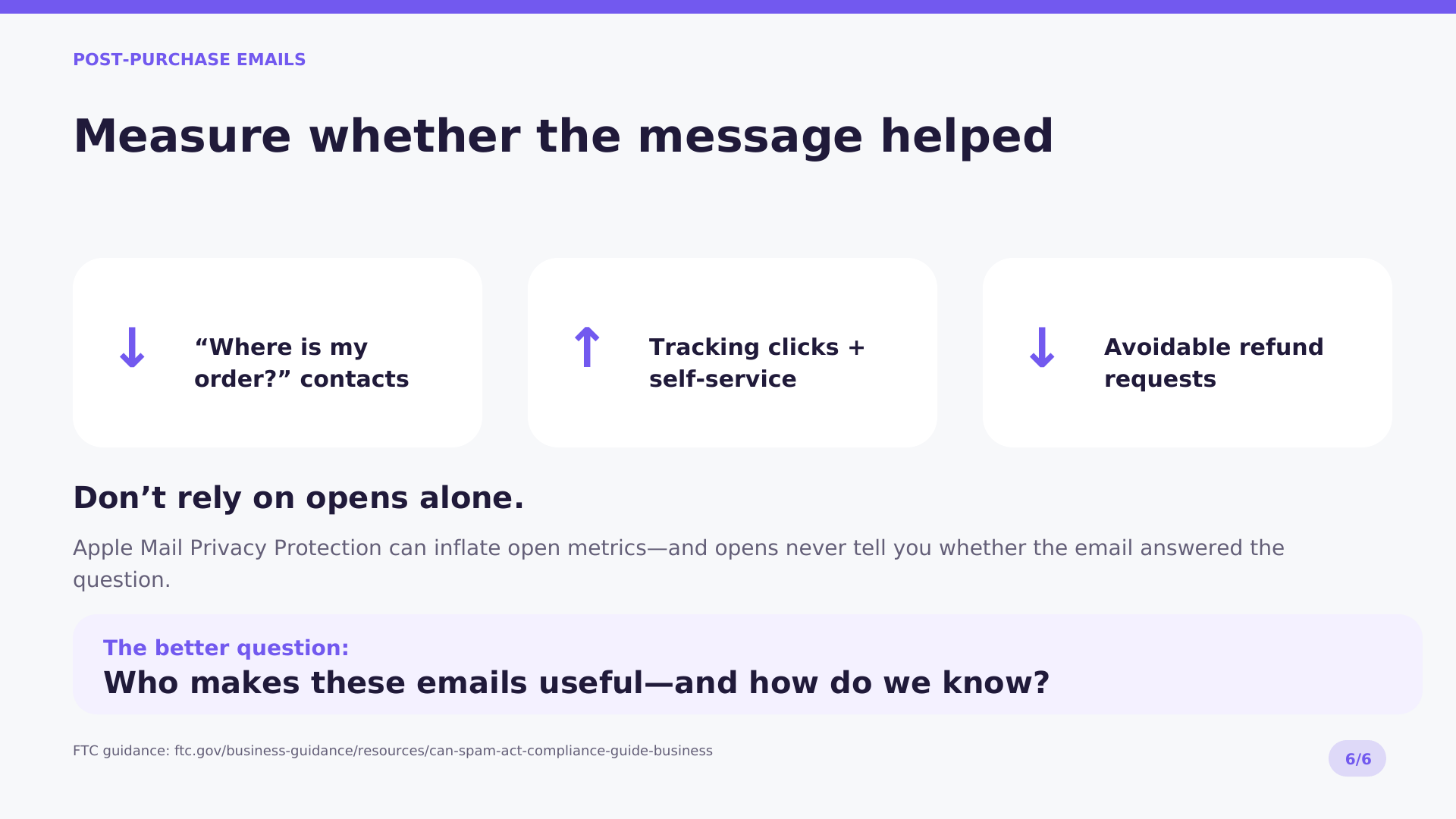
Open rate is not enough.
Apple’s Mail Privacy Protection privately downloads remote content in the background, which prevents senders from reliably determining whether protected users opened a message. (Source: Apple Support)
More useful post-purchase metrics include:
- Tracking-link clicks
- Self-service usage
- “Where is my order?” support contacts
- Delivery-related complaints
- Return-instruction clicks
- Avoidable refund requests
- Failed delivery notifications
- Time to resolve an exception
- Customer satisfaction after delivery
The right question is not simply, “Did someone open the email?”
It is:
Did the message help the customer complete the next step without contacting support?
Post-purchase email checklist
Before launching or updating a post-purchase message, check:
- Is the subject line primarily about the transaction?
- Does the order information appear first?
- Can customers immediately find the next step?
- Are tracking links and delivery dates accurate?
- Is any promotional content legally permitted?
- Could an offer distract from essential information?
- Are service and promotional messages sent through appropriate streams?
- Can each team identify what it owns?
- Are you measuring customer outcomes rather than opens alone?
Post-purchase emails may have marketing impact, but their first responsibility is to help the customer.
Frequently asked questions
Is an order confirmation a transactional email?
Usually, yes. An order confirmation primarily confirms a transaction the customer already agreed to. Promotional additions may affect how a mixed message is treated.
Can you include product recommendations in a shipping email?
Potentially, but the rules depend on the recipient’s jurisdiction and your legal basis for marketing. Recommendations should never obscure the shipping information.
Do transactional emails need an unsubscribe link?
Not always. Gmail’s one-click unsubscribe requirement excludes transactional messages, but promotional content may change the applicable legal and platform requirements. Check the rules for every jurisdiction where you send.
Should transactional and marketing emails use separate sending streams?
It is generally a sensible practice. Separation makes consent management, reputation monitoring, troubleshooting, and message classification clearer.
What is the best metric for an order-update email?
There is no single best metric. Track whether customers reach the information or action they need and whether the message reduces avoidable support contacts.


 Your Privacy Choices
