
- Home
- Comparing Alternatives
- Top 6 Klaviyo Alternatives in ...


Last updated: November 2026
The best Klaviyo alternatives in 2026 are Sendigram for small businesses that want to pay for emails sent rather than contacts stored, ActiveCampaign for flexible automation with a CRM, Brevo for email plus other channels, Omnisend and Drip for online stores, and Constant Contact for social media and event marketing.
Choosing an email marketing platform is easier when you know what you’re comparing. Klaviyo is built around ecommerce marketing and customer data, but its pricing model, features, and learning curve may not suit every business. Other platforms may be a better fit if you want simpler automation, different channels, or a different way to pay.
In this guide, we compare six Klaviyo alternatives: Sendigram, ActiveCampaign, Brevo, Omnisend, Constant Contact, and Drip. We’ll look at what each platform is best suited for, how its plans work, and what to check before switching.
In this article:
- What Is Klaviyo?
- Klaviyo Alternatives at a Glance
- How We Chose These Alternatives
- 1. Sendigram
- 2. ActiveCampaign
- 3. Brevo
- 4. Omnisend
- 5. Constant Contact
- 6. Drip
- How to Choose a Klaviyo Alternative
- Frequently Asked Questions
- To Sum Up
What Is Klaviyo?
Klaviyo is a marketing platform focused on email, SMS, and ecommerce customer data. Businesses can use it to send campaigns, create automated flows, segment customers, and measure campaign performance.
Its free plan currently includes up to 250 profiles and 500 email sends per month. Paid pricing is based on active profiles, and plan limits and features vary. Check the current pricing page for the cost at your list size before comparing it with another platform.
Klaviyo Alternatives at a Glance
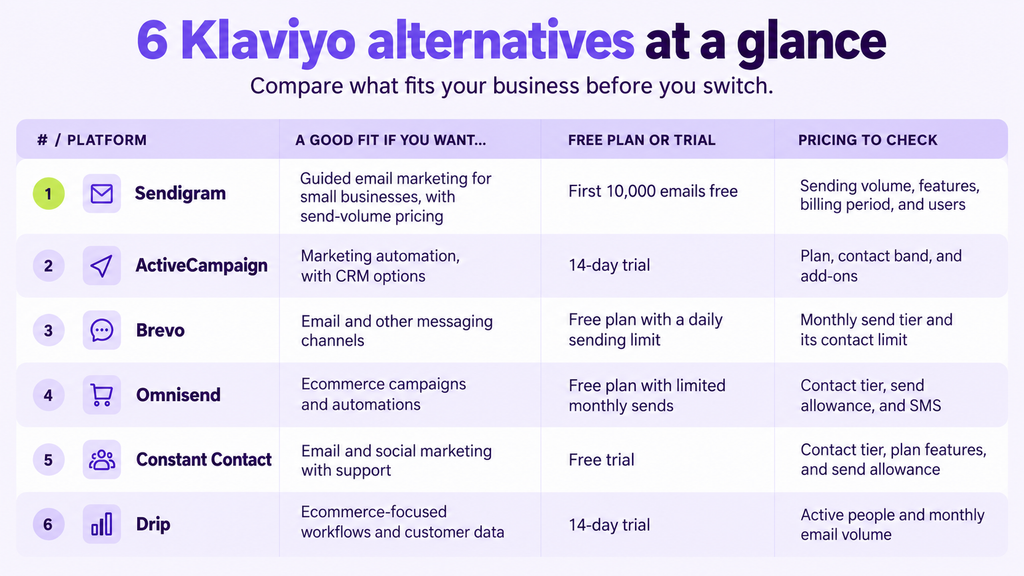
The right alternative depends on what you need most. These summaries are starting points; compare each plan against your own contact count, sending volume, and required features.
| Platform | Best for | Pricing based on | Free option |
|---|---|---|---|
| Klaviyo (for reference) | E-commerce brands that use customer data | Active profiles | 250 profiles, 500 emails/month |
| Sendigram | Small businesses without an email marketer | Emails sent (unlimited contacts) | 10,000 emails, no credit card |
| ActiveCampaign | Flexible automation with CRM | Contacts | Free trial only |
| Brevo | Email plus SMS and other channels | Email volume | 300 emails/day |
| Omnisend | E-commerce stores | Contacts | 250 contacts, 500 emails/month |
| Constant Contact | Social media and event marketing | Contacts | Free trial only |
| Drip | Online stores using shopping data | Contacts | Free trial only |
How We Chose These Alternatives
We compared each platform with Klaviyo on pricing model and free-plan limits, e-commerce and automation features, ease of use, and the type of business it suits best. Pricing details come from each provider’s official site. Sendigram is our own product, so we review it against the same criteria and list its drawbacks too.
1. Sendigram
Best suited to: small businesses that want guided email marketing tools and pricing based on emails sent rather than contacts stored.
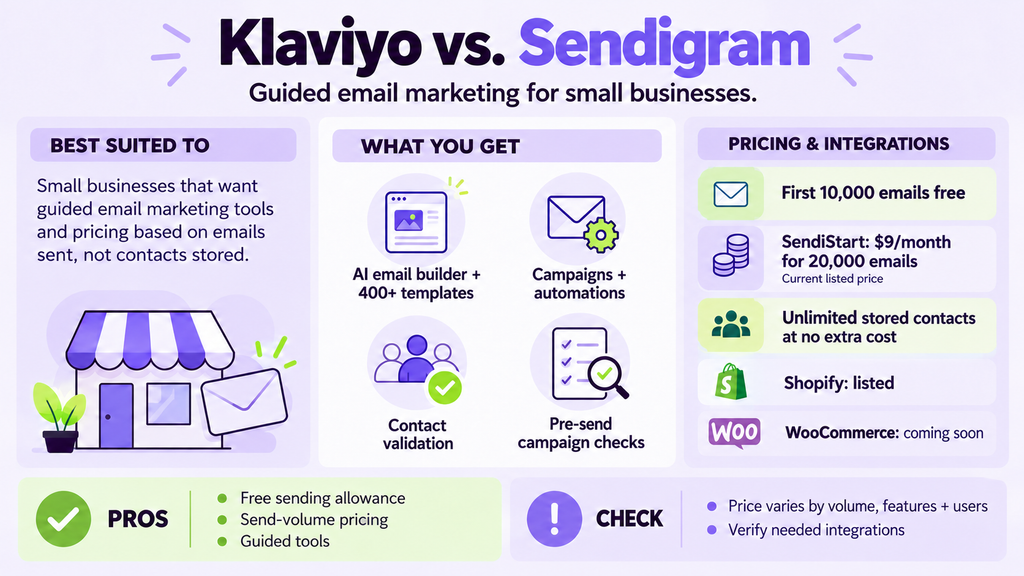
Sendigram is an AI-assisted email marketing platform designed for small business owners who don’t have a dedicated email marketing team. Instead of starting from a blank canvas, you can use the built-in AI assistant to create templates, campaigns and automations through a chat-style interface. You also get 400+ free responsive templates, a drag-and-drop builder, contact management and segmentation, campaign scheduling, performance reporting, and automated email sequences.
Pricing: Sendigram includes your first 10,000 emails for free, with no credit card required. Paid plans are priced by the number of emails you send, not the contacts you store, and start at $6 per month for 5,000 emails (SendiStart). At 20,000 emails per month, plans cost $16, $20, or $25 on SendiStart, SendiPro, and SendiMax.
Pros
- Unlimited stored contacts at no extra cost
- Free plan with up to 10,000 emails per month
- AI email creation, templates, automations, and pre-send checks
Cons
- Plan costs depend on sending volume, features, and user seats
- WooCommerce is listed as coming soon
- Businesses with specific channel or integration needs should verify those requirements before switching
2. ActiveCampaign
Best suited to: businesses that want flexible marketing automation and may also need CRM capabilities.
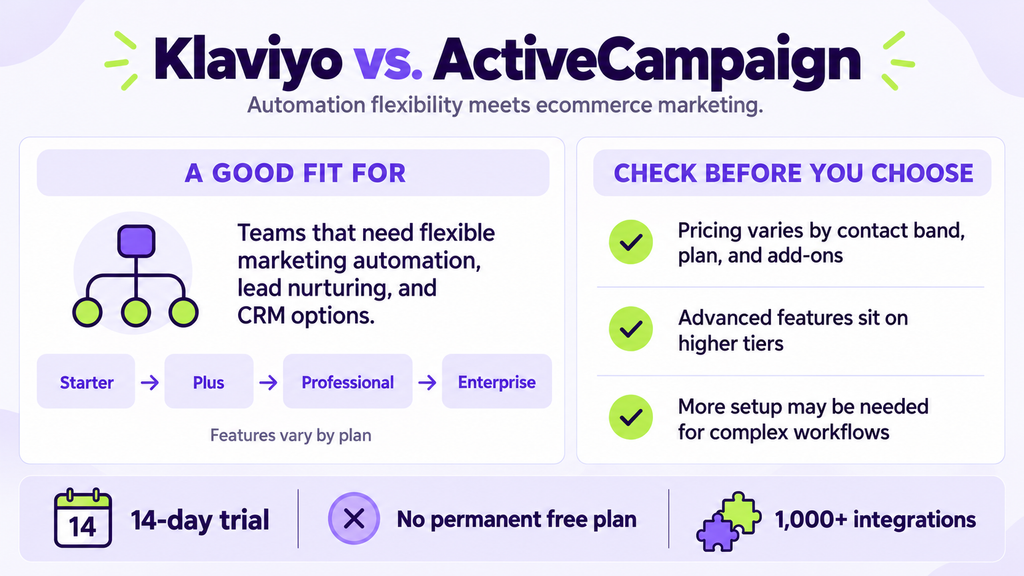
ActiveCampaign offers email marketing and automation across four main plans: Starter, Plus, Professional, and Enterprise. Features vary by plan. For example, its help documentation lists lighter automation on Starter, with more advanced automation and reporting on higher tiers. CRM features are available through plans or add-ons, so check what’s included in the specific offer you’re considering. ActiveCampaign lists more than 1,000 integrations and offers a 14-day trial.
Compared with an ecommerce-focused platform, ActiveCampaign may be a better fit when you need workflows that extend beyond store activity, such as lead nurturing or sales processes. Consider how much setup and ongoing management your team is comfortable handling.
Pricing: The price depends on your contact band, plan, and any add-ons. Check the current quote for the features you need; don’t rely on older starting-price examples.
Pros
- A range of automation capabilities across its plans
- CRM options and integrations with other business tools
- A 14-day trial to explore the platform
Cons
- Feature access varies by plan and add-on
- More advanced automation may take time to set up
- There is no permanent free plan
3. Brevo
Best suited to: businesses looking for email marketing alongside other communication tools.
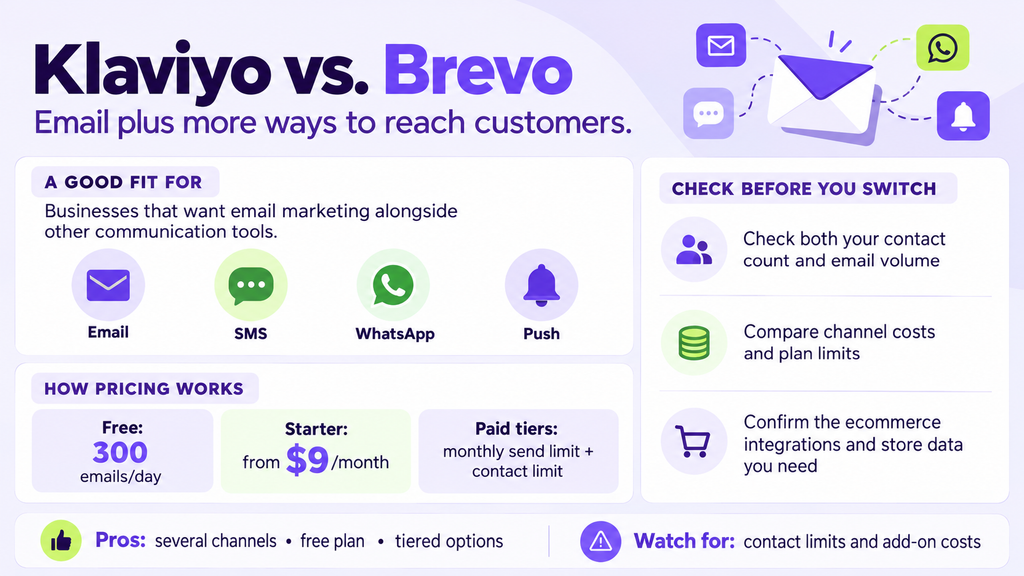
Brevo offers email marketing and additional channels, including SMS, WhatsApp, and push messaging. Its free plan has a daily email limit. Paid plans use monthly sending tiers, and those tiers can also set how many contacts you can store. The Starter plan currently starts at $9 per month; check the plan details for the contact limit and sending allowance attached to your tier.
Brevo may suit a business that wants email and other messaging tools in one account. If you send infrequently to a large list, compare its contact limits as well as the email volume: the paid plan structure is not simply unlimited contacts with a send-based price.
Pros
- Supports several communication channels
- A free plan is available
- Paid tiers let you compare sending volume and contact limits
Cons
- The plan’s contact limit may matter alongside its sending limit
- Costs and features change by tier and add-on
- Compare the ecommerce integrations and store data you need before switching
4. Omnisend
Best suited to: ecommerce businesses looking for email campaigns and store-related automations.
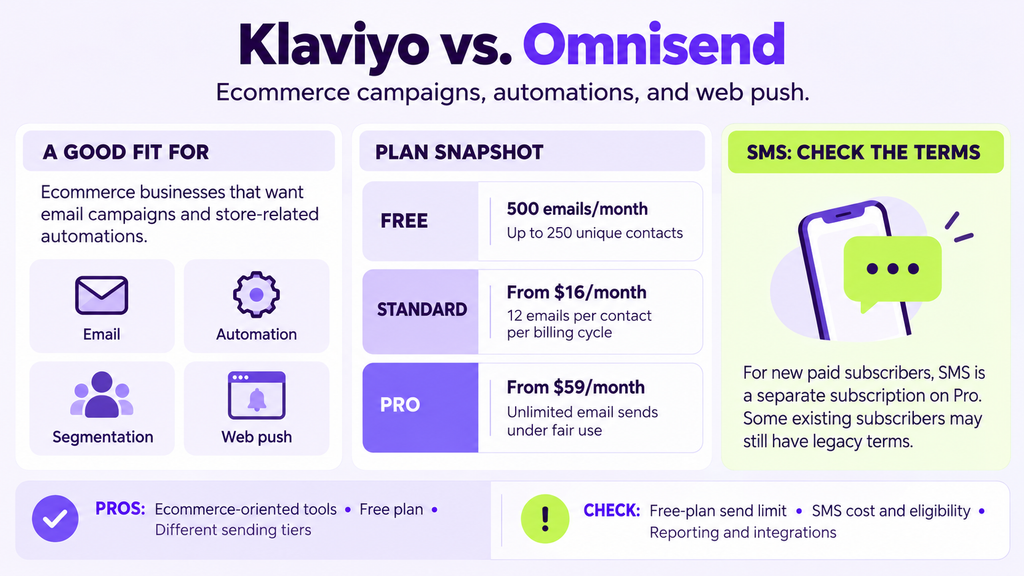
Omnisend offers email marketing, automations, segmentation, and web push features. Its free plan allows up to 500 emails per month to a maximum of 250 unique contacts. The Standard plan starts at $16 per month, and Pro starts at $59 per month. Standard’s email allowance is based on contact count; Pro supports unlimited email sends under a fair-use policy.
Check the SMS terms carefully if you plan to use that channel. For new paid subscribers, SMS is a separate subscription on Pro rather than credits bundled into the plan. The current rules differ for some existing subscribers on legacy terms.
Pros
- Ecommerce-oriented campaign and automation features
- Free plan available for trying core features
- Plan options for different sending volumes
Cons
- The free plan has a low monthly send allowance
- SMS availability and cost depend on plan and subscription date
- Compare the reporting and integrations you rely on before migrating
5. Constant Contact
Best suited to: small businesses that want email marketing alongside social media and event-related tools.
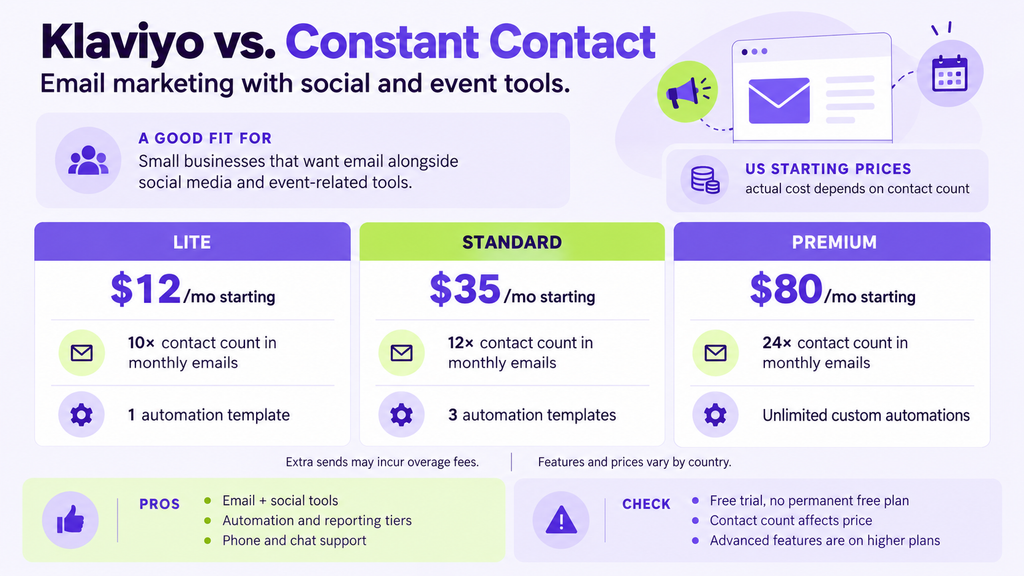
Constant Contact currently offers Lite, Standard, and Premium plans. In the US, listed starting prices are $12, $35, and $80 per month, respectively. The actual price depends on contact count. Each plan also has a monthly email allowance tied to list size: 10 times the contact count on Lite, 12 times on Standard, and 24 times on Premium. Additional sends may incur overage fees.
The plans differ in automation, segmentation, and reporting. For example, the current pricing page lists one automation template on Lite, three on Standard, and unlimited custom automations on Premium. Constant Contact has a free trial, but it is a paid platform rather than a permanently free plan. Plan names, features, and prices can vary by country, so check the pricing page for your region.
Pros
- Combines email and social media tools
- Offers different levels of automation and reporting
- Includes phone and chat support in its listed plans
Cons
- No permanent free plan
- Contact count and monthly send allowance both affect cost
- More advanced automation and segmentation are tied to higher plans
6. Drip
Best suited to: online stores that want to use customer and shopping activity in their email marketing.
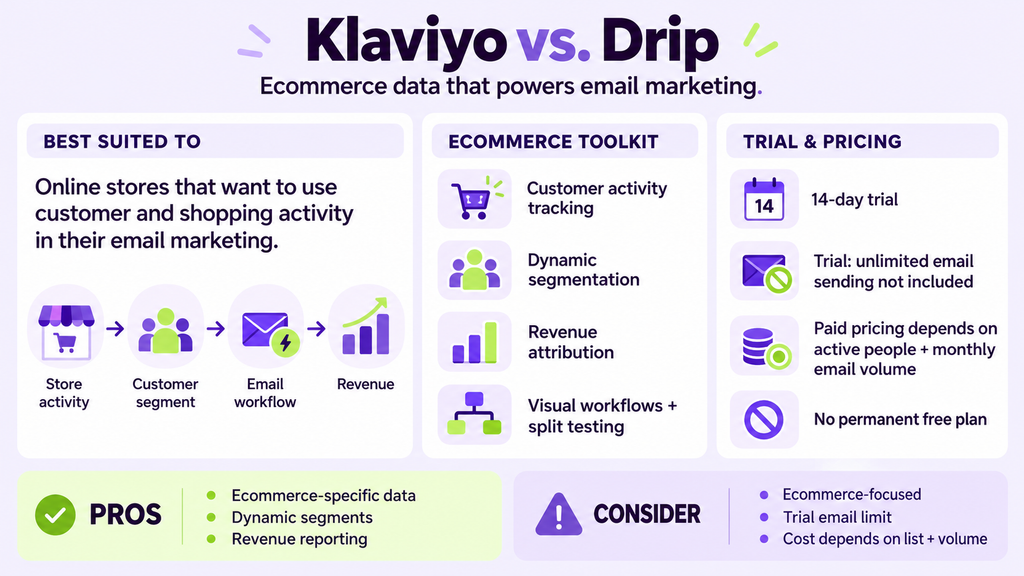
Drip focuses on ecommerce marketing. Its feature list includes customer activity tracking, dynamic segmentation, revenue attribution, and visual automation workflows. It offers a 14-day trial; unlimited email sending is not available during the trial.
Drip’s pricing depends on the number of active people in your account and the volume of email you send during the month. That means you should compare both your list size and sending habits when estimating the cost.
Pros
- Ecommerce-specific customer data and workflows
- Dynamic segments and revenue reporting
- Visual automation tools, including workflow split testing
Cons
- Designed primarily for ecommerce businesses
- No permanent free plan
- The trial has limits, and paid costs depend on both audience size and email volume
How to Choose a Klaviyo Alternative
Before switching, compare platforms using the same contact count and approximate monthly email volume. Then check whether the plan includes the features you actually use.
Ask:
- Can it connect to your ecommerce platform and other essential tools?
- Can you recreate your welcome, abandoned-cart, post-purchase, and win-back automations?
- Can you use your existing customer data to build the segments you need?
- What will you pay at your current list size and sending volume?
- Are SMS or other channels included, sold separately, or limited by plan?
- What happens to your contacts, templates, consent records, and active automations during migration?
If your business depends on advanced ecommerce data and flows, shortlist platforms built for online stores. If your needs are broader or simpler, compare platforms by ease of use, channel coverage, and total cost.
Frequently Asked Questions
Does Klaviyo have a free plan?
Yes. Klaviyo’s free plan includes up to 250 profiles and 500 email sends per month. Paid plans are priced by active profiles, so costs rise as your list grows.
What is the cheapest Klaviyo alternative?
It depends on how you send. If you have a large list but send occasionally, Sendigram is often cheapest because it charges for emails sent and stores unlimited contacts, with paid plans from $6 per month. Brevo also prices by email volume and has a free plan of 300 emails per day.
Which Klaviyo alternative is best for e-commerce?
Omnisend and Drip are built for online stores and use shopping activity in automations. They are the closest alternatives if you rely on Klaviyo’s e-commerce features.
Which Klaviyo alternative is easiest to use?
Sendigram and Constant Contact are the most beginner-friendly options. Sendigram adds guided onboarding and an AI assistant that helps you create emails, campaigns, and automations.
To Sum Up
There isn’t one best Klaviyo alternative for every business. ActiveCampaign may suit teams that need flexible marketing automation; Brevo offers email alongside other messaging channels; Omnisend and Drip focus more closely on ecommerce use cases; and Constant Contact combines email with social and event marketing tools.
Compare the plans using your own contact count, sending volume, channels, and must-have automations. Pricing and plan details can change, so verify the provider’s current terms before making a decision. This article’s plan information was checked on October 16, 2026.
Comparing other tools? See our guides to ActiveCampaign alternatives, Mailchimp alternatives, and Brevo alternatives.


 Your Privacy Choices
