
- Home
- Email Tips and Tricks
- What Are the Best Lead Magnets ...


The best lead magnets for small businesses solve one specific problem, provide a quick result, and take only a few minutes to use. Instead of creating a long e-book, try a one-page cheat sheet, self-assessment, calculator, or benchmark snapshot.
A lead magnet does not need 50 pages, six chapters, and a cover that looks ready for an airport bookshop.
It needs to be useful.
Small business owners often make lead magnets more complicated than necessary. They start writing an “ultimate guide,” discover that it has quietly become a second job, and postpone launching the signup form for another month.
Meanwhile, their potential customer probably wanted one clear answer they could use before lunch.
This guide explains what makes a lead magnet effective, gives four practical formats for small businesses, and shows how to turn the initial download into a useful email relationship.
What is a lead magnet?
A lead magnet is a useful resource that a business offers in exchange for a visitor’s contact information, usually an email address.
Common lead magnets include:
- Checklists
- Templates
- Quizzes and assessments
- Calculators
- Benchmark reports
- Guides and e-books
- Worksheets
- Free tools
- Webinars or short courses
The goal is not merely to collect an email address. A good lead magnet gives the subscriber a small but meaningful result and introduces the kind of help your business provides.
For example, an accountant might offer a quarterly tax checklist. A business coach might offer a two-minute capacity assessment. A web agency might offer a website conversion scorecard.
Each resource solves a problem connected to the service the business eventually wants to sell.
What makes a good lead magnet for a small business?
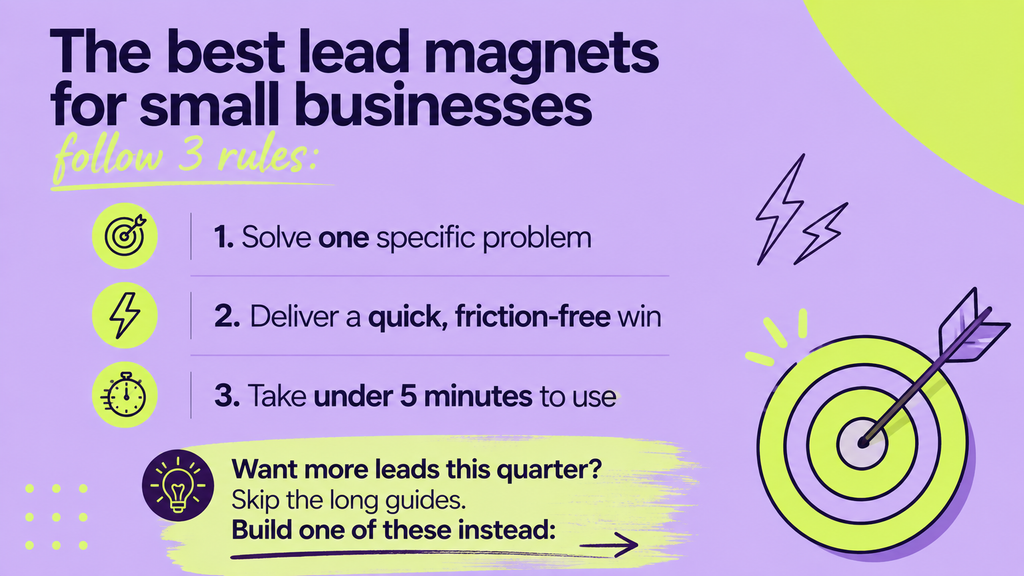
Strong lead magnets usually follow three rules.
1. They solve one specific problem
“Everything you need to know about marketing” is too broad.
“Seven things to check before sending a marketing email” is clear. The reader immediately knows what the resource will help them do.
The narrower the problem, the easier it is to create a useful resource—and the easier it is for the right person to recognize that they need it.
2. They deliver a quick, friction-free win
A subscriber should not need a free weekend, a printer, and a fresh set of highlighters to get value from your lead magnet.
Give them something they can use immediately:
- A decision
- A score
- A calculation
- A short action list
- A comparison
- A completed first step
The result does not need to solve the customer’s entire problem. It should help them make visible progress.
3. They take less than five minutes to use
People download resources with good intentions and crowded calendars.
A lead magnet that takes a few minutes to understand and use has a better chance of becoming part of someone’s day rather than part of their downloads folder.
Long-form guides can still work when the topic genuinely needs depth. But length is not a benefit by itself. Start with the smallest resource that can deliver the promised outcome.
Four practical lead magnet ideas for small businesses
1. Create a one-page cheat sheet
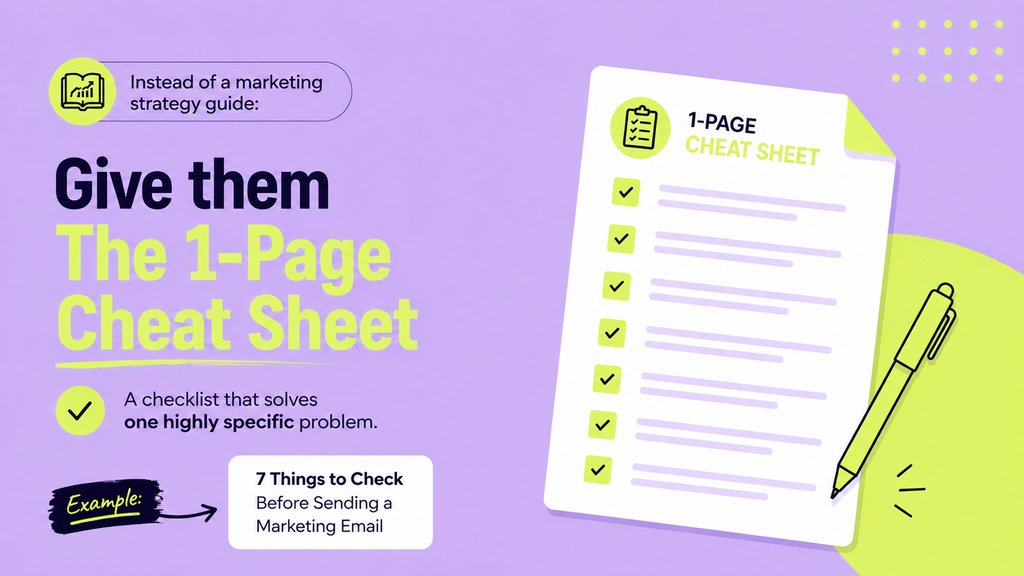
A cheat sheet turns a process, decision, or quality check into one useful page.
It works especially well when customers repeatedly ask the same question or tend to miss the same steps.
Examples include:
- Seven things to check before sending a marketing email
- The five photos every property listing needs
- A pre-launch checklist for online stores
- Ten questions to ask before hiring a contractor
- A monthly bookkeeping checklist for freelancers
The best cheat sheets are highly specific. “Marketing checklist” is vague. “The seven-point email check to complete before pressing Send” describes a clear moment and result.
How to create it
- Choose one task your customer wants to complete correctly.
- List the essential steps or checks.
- Remove explanations that are not needed to take action.
- Fit the result onto one page if possible.
- Include a clear next step for anyone who needs more help.
Use this format when the customer knows what they need to do but wants confidence that they have not forgotten anything.
2. Build a short self-assessment
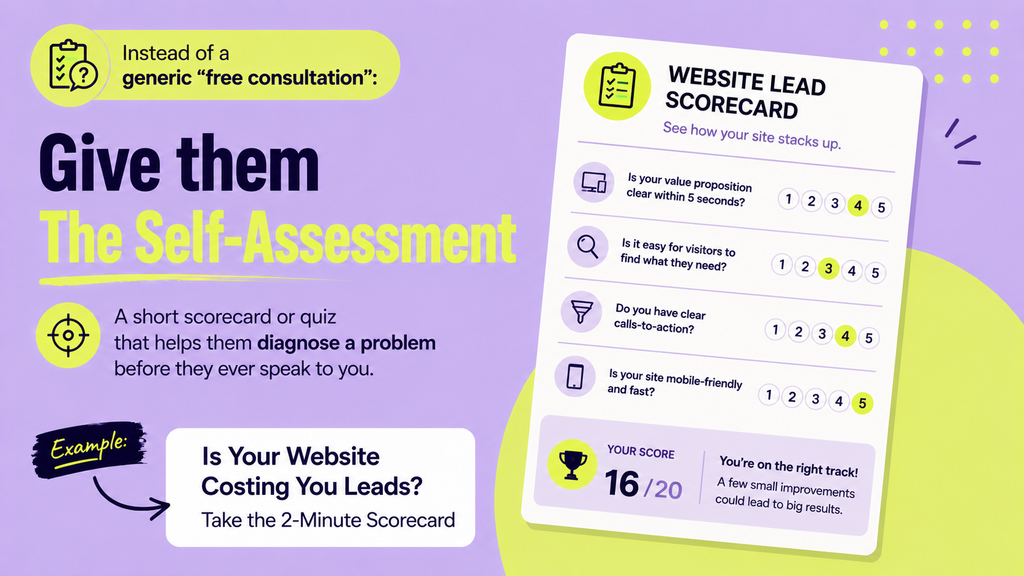
A self-assessment helps a potential customer diagnose a problem before speaking with you.
Instead of offering a generic “free consultation,” give people a short scorecard or quiz that shows where they stand.
Examples include:
- Is your website costing you leads?
- How healthy is your email list?
- Is your business ready to hire its first employee?
- How efficient is your appointment-booking process?
- Is your online store ready for the holiday season?
A useful self-assessment usually contains five to ten focused questions. The result should explain what the score means and recommend one or two next steps.
How to create it
- Identify the signs of a healthy or unhealthy situation.
- Turn those signs into simple questions.
- Use a clear scoring system.
- Divide the results into a few understandable ranges.
- Give each range an appropriate recommendation.
Keep the questions neutral. If every answer appears designed to prove that the reader urgently needs your service, the assessment will feel like a sales form wearing a small moustache.
Use this format when customers need help recognizing the problem or understanding its seriousness.
3. Offer a simple calculator
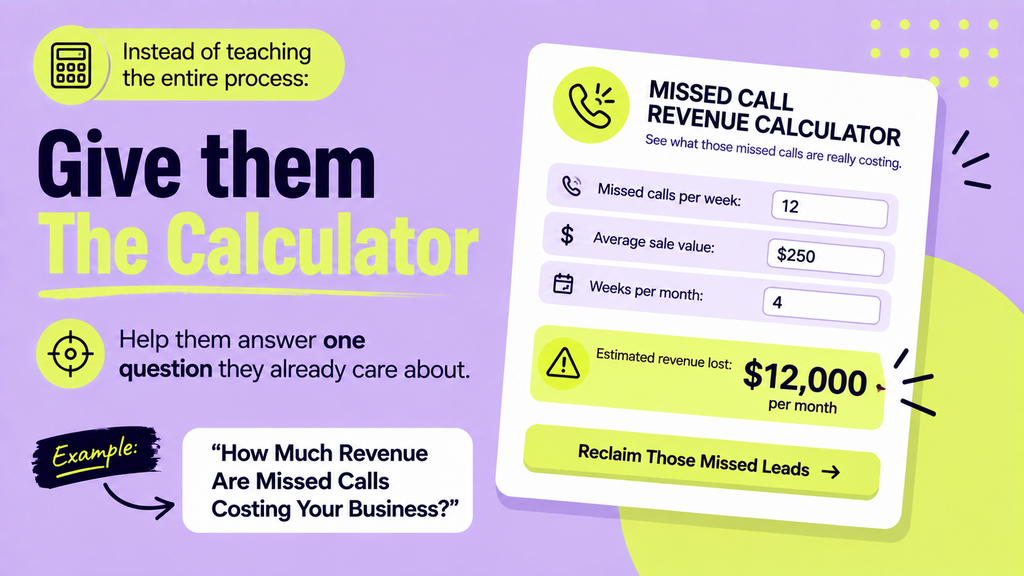
A calculator answers one question the customer already cares about, usually involving time, money, capacity, or potential results.
For example, a missed-call revenue calculator could ask for:
- Missed calls per week
- Average sale value
- Number of working weeks or months
It can then estimate how much potential revenue may be connected to those missed opportunities.
Other calculator ideas include:
- Delivery-cost calculator
- Project-pricing calculator
- Event-budget calculator
- Employee turnover cost estimator
- Return-on-investment calculator
- Email campaign revenue estimator
How to create it
- Choose one calculation people currently do manually or avoid doing altogether.
- Ask only for the inputs necessary to produce the answer.
- Explain the assumptions behind the result.
- Keep the output easy to understand.
- Suggest a useful next action based on the result.
Avoid pretending that a rough estimate is a guaranteed outcome. A trustworthy calculator shows its assumptions and explains that the result is indicative.
Use this format when the value or cost of a problem becomes more persuasive once it is expressed as a number.
4. Share a benchmark snapshot
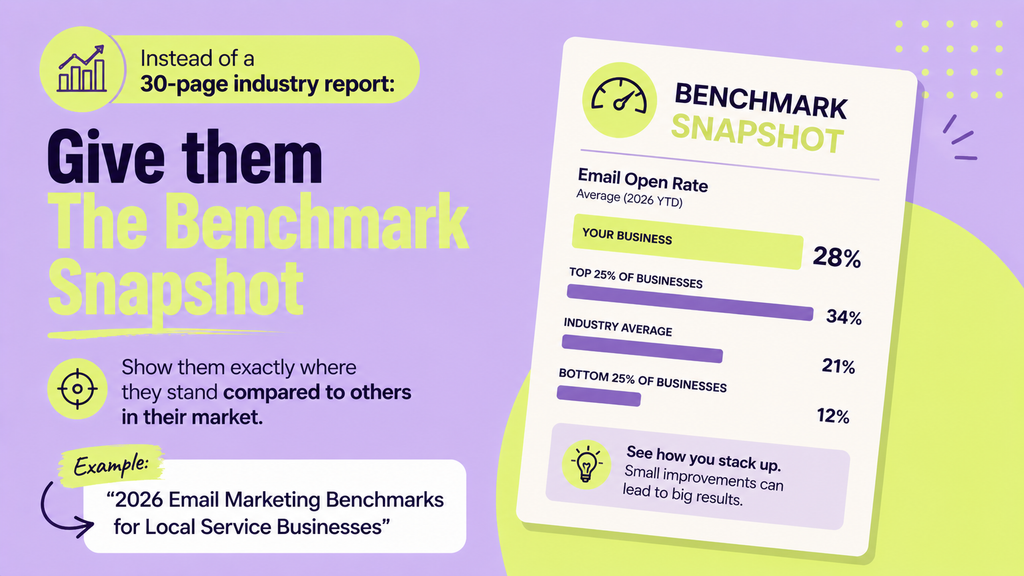
A benchmark snapshot shows customers where they stand compared with a relevant group.
It can answer questions such as:
- Is this result normal for my industry?
- Are we ahead or behind similar businesses?
- Which metric needs attention first?
- What does “good” look like?
Examples include:
- Email marketing benchmarks for local service businesses
- Average response times for small support teams
- Typical booking conversion rates by business type
- Website speed benchmarks for local retailers
- Social media posting benchmarks for independent restaurants
You do not need a 30-page industry report. A one-page snapshot with a few well-sourced comparisons may be more useful.
How to create it
- Choose a small group of metrics customers regularly ask about.
- Use current, credible data and link to the original sources.
- Explain how each metric is calculated.
- Show the comparison visually.
- Add a short explanation of what to investigate next.
Be careful with averages. Industry, audience, price, location, and methodology can all change what a “good” result looks like. Present benchmarks as context, not universal targets.
Use this format when customers already have results but do not know how to interpret them.
How do you choose the right lead magnet?
Start with the customer’s situation, not the file format you feel like making.
Ask:
- What question comes up repeatedly in sales conversations?
- What small mistake causes customers the most trouble?
- What decision stops people from moving forward?
- What calculation would make the cost of the problem clearer?
- What result do customers struggle to interpret?
Then match the problem to the format:
| Customer need | Best lead magnet format |
|---|---|
| “I don’t want to miss anything.” | Cheat sheet |
| “I’m not sure whether I have a problem.” | Self-assessment |
| “I need to understand the cost or value.” | Calculator |
| “I don’t know whether my result is good.” | Benchmark snapshot |
The best idea is usually close to the product or service you offer but still useful to someone who is not ready to buy.
How should you promote a lead magnet?
A useful resource still needs a clear invitation.
Place it where the related problem naturally appears:
- On a relevant blog article
- On a dedicated landing page
- In the website navigation or footer
- Inside a useful LinkedIn post
- In an exit-intent or timed form, used carefully
- On service or product pages
- In a webinar follow-up
- In an email signature
Describe the result, not merely the format.
“Download our free PDF” tells the visitor almost nothing.
“Check your campaign in five minutes before pressing Send” explains what they will gain.
Your signup form should ask only for information you genuinely need. In many cases, an email address and first name are enough.
What should happen after someone downloads it?
The lead magnet earns attention. Email marketing keeps it.
At minimum, send:
- A delivery email: Provide the resource immediately and remind the subscriber why it is useful.
- A practical follow-up: Help them use it or avoid a common mistake.
- A relevant next step: Share another resource, invite a reply, or introduce the service connected to the problem.
Do not jump from “Here is your checklist” to “Would you like to book a sales call?” before the attachment has finished downloading.
Continue the same promise that attracted the subscriber. If they downloaded a website scorecard, send useful website advice — not a sudden series about unrelated services.
With an email automation, the resource and follow-up messages can be delivered at the right time without requiring someone to send each message manually.
A small resource can begin a valuable relationship
A lead magnet does not need to demonstrate everything you know. It needs to help the right person solve one real problem.
Start small:
- One problem
- One useful result
- One simple format
- One clear next step
The cheat sheet, assessment, calculator, or benchmark is only the beginning. What matters next is whether your emails continue to be useful after the subscriber has given you their attention.
Ready to follow up without doing everything manually? Try Sendigram for free to create emails, schedule campaigns, and automate subscriber follow-ups in one place.
Frequently asked questions about lead magnets
What is the best lead magnet for a small business?
The best format depends on the customer’s immediate need. Use a cheat sheet for a process, a self-assessment for diagnosis, a calculator for cost or value, and a benchmark snapshot for comparison.
Does a lead magnet need to be an e-book?
No. A short checklist, template, quiz, calculator, or one-page report can be more practical. Choose the shortest format that delivers the promised result.
Should a lead magnet be free?
Most lead magnets are offered without payment in exchange for contact information and consent to receive relevant communication. The value should still be high enough to create a useful first experience with your business.
How long should a lead magnet be?
There is no required length. It should be long enough to solve the promised problem and no longer. Many effective resources can be used in five minutes or less.
What information should a lead magnet form collect?
Ask only for information you will actually use. An email address may be enough; a first name can support personalization. Additional fields can create unnecessary friction unless they improve segmentation or the resource itself.
What emails should follow a lead magnet download?
Send the resource immediately, follow with practical guidance related to it, and then offer a relevant next step. Keep the follow-up aligned with the reason the person subscribed.


 Your Privacy Choices
