
- Home
- Fundamentals of Email Marketing
- Does Email Marketing Work With ...


Does email marketing work without a strong brand
Yes. A small business does not need widespread brand recognition for email marketing to work. It needs an audience that has chosen to hear from it, a clear reason for each message and enough trust for the subscriber to keep opening.
A recognizable brand can make the first open easier. It cannot rescue irrelevant campaigns, poor targeting or a list that never asked to receive the email. Brand awareness is helpful; permission and relevance are foundational.
That distinction emerged repeatedly in an informal discussion involving more than 40 small-business owners and email marketers. The responses varied in wording, but the conclusion was remarkably consistent: businesses earn email results through attention and trust, not fame alone.
Why businesses confuse brand recognition with email performance
Large brands often have advantages: existing demand, recognizable products, more customer data and larger creative teams. Their emails may perform well partly because subscribers already understand the company and its offer.
But this can create the wrong lesson for smaller businesses. What matters is not whether millions of people know the sender. What matters is whether the specific person receiving the email recognizes the sender, remembers why they subscribed and expects something useful.
A local shop, consultant or small software company can build that kind of recognition without becoming famous. In email, familiarity inside a small, relevant audience can be more valuable than broad awareness among people who do not care.
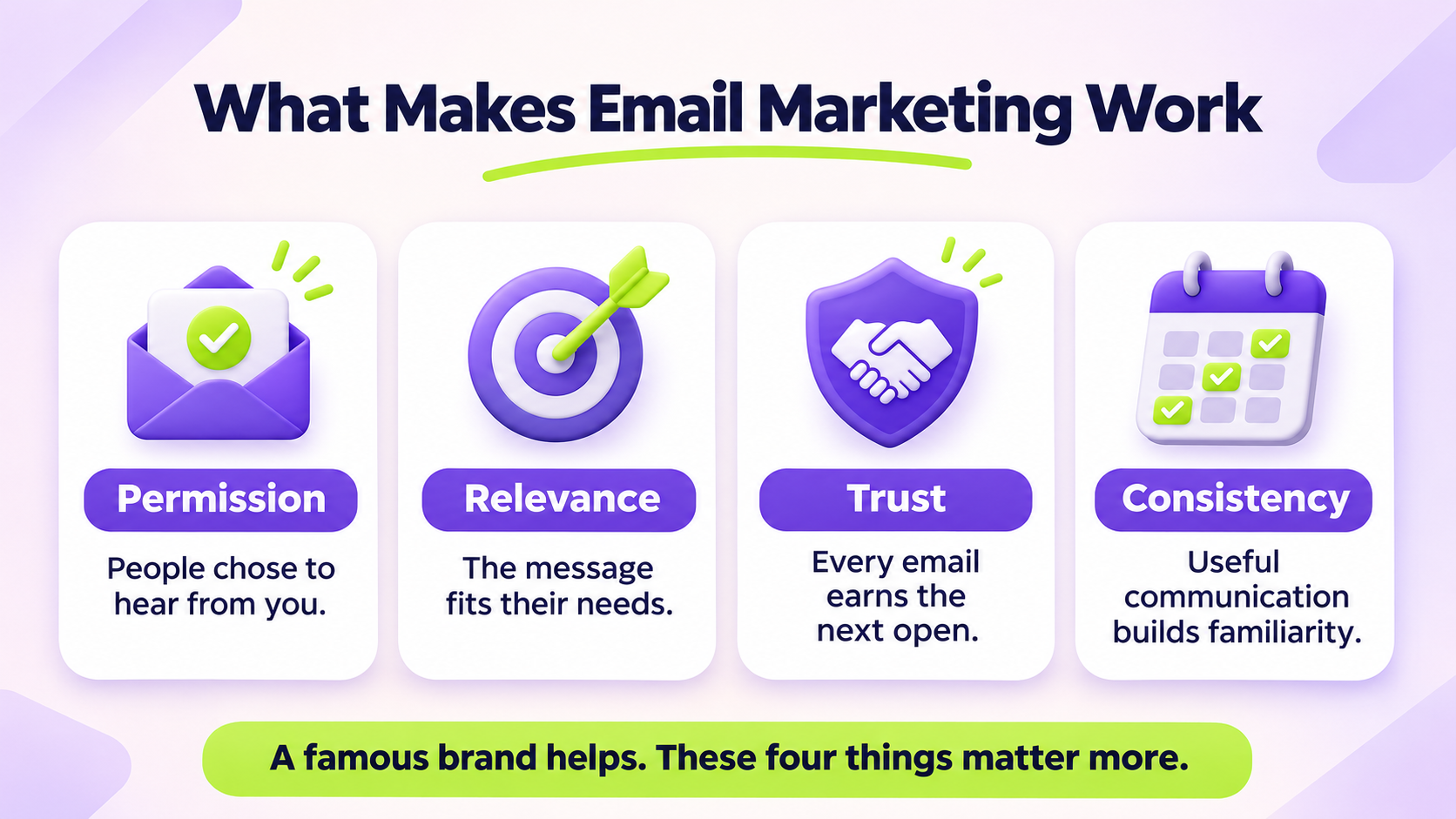
The four conditions that make email marketing work
1. Permission
Email performs best when people have deliberately chosen to receive it. An opt-in creates context: the subscriber knows who the sender is and has at least one reason to expect a message.
This does not mean every opt-in is equally valuable. A vague giveaway can attract people who want the prize rather than the business. A better signup promise is specific: weekly local offers, practical bookkeeping tips, product tutorials or early access to new stock.
2. Relevance
Recognition may earn a glance. Relevance earns attention. The email should connect with something the subscriber wants, needs or recently did.
Relevance can come from simple information: what someone purchased, which guide they downloaded, whether they are new or returning, or which topic they selected at signup. Small businesses do not need a complicated personalization engine. They need a sensible reason for sending the message to that person.
3. Trust
Every campaign influences the next one. Helpful emails make future opens more likely. Repetitive promotions, misleading subject lines and irrelevant automation teach people to ignore the sender.
Trust is therefore cumulative. It comes from accurate promises, recognizable sending patterns, useful content and a respectful unsubscribe experience. A subscriber should never have to guess why the email arrived or struggle to stop it.
4. Consistency
A small business becomes recognizable through consistent, worthwhile contact. This does not mean sending every day. It means choosing a realistic rhythm and maintaining a clear standard of usefulness.
A monthly email that reliably helps the reader can build more familiarity than a burst of five messages followed by three months of silence.
Is email marketing a channel for strangers
Usually, no. Email is strongest after someone has entered the relationship: made a purchase, requested information, attended an event, created an account or explicitly joined the list.
That is why email is particularly effective for retention, education and repeat sales. It gives a business a direct way to continue a relationship that began elsewhere. Social media, search, referrals and partnerships may create the first discovery; email helps turn that initial interest into familiarity and action.
Treating a permission-based email list like a database of strangers weakens this advantage. If recipients do not know the sender or understand why they are receiving the message, the problem is not insufficient fame. It is missing context and permission.
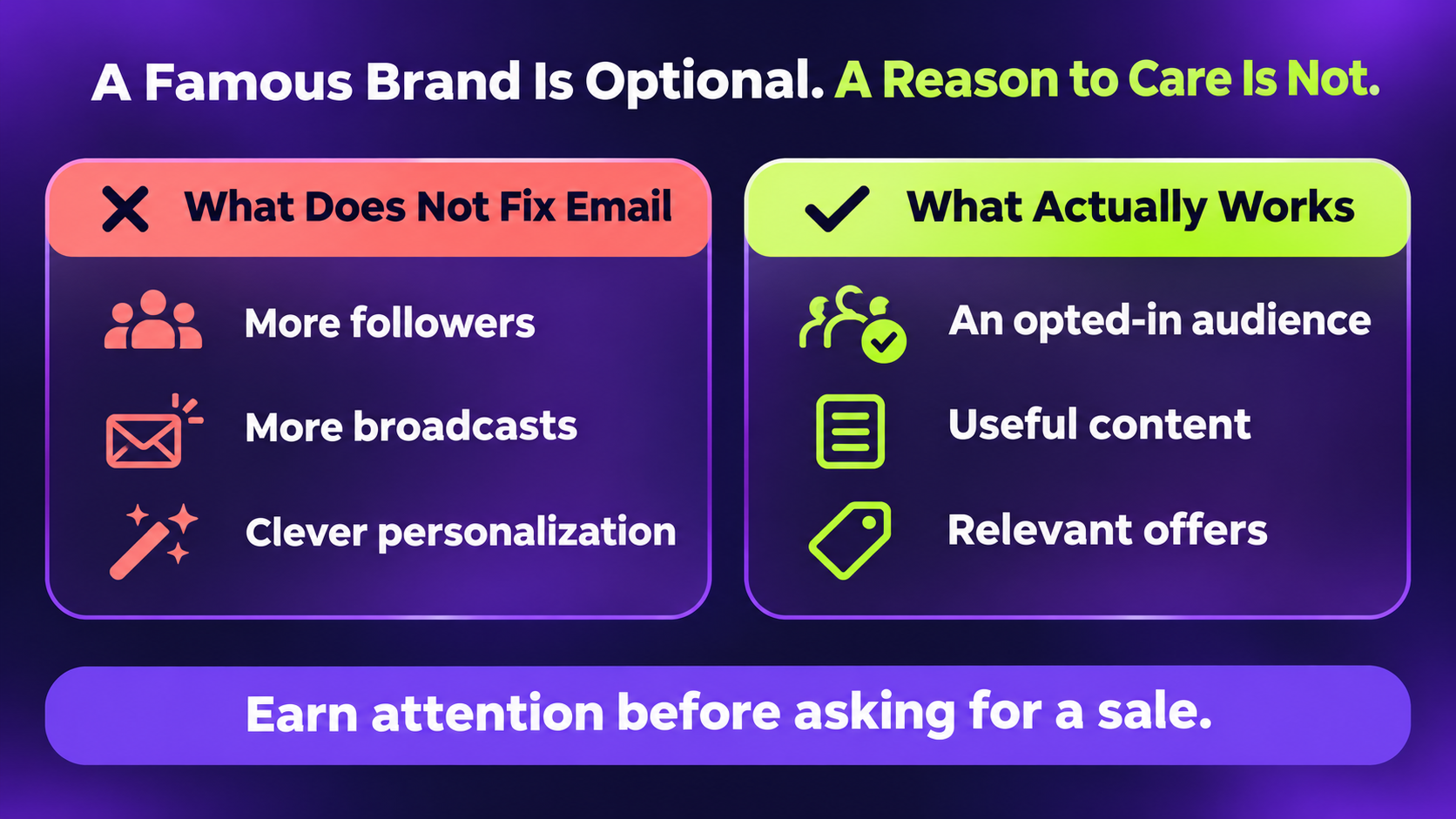
Why a small engaged list can outperform a large quiet one
Subscriber count is easy to display, but it is a poor measure of relationship quality. Five hundred people who regularly read, click or buy can create more value than 5,000 people who barely remember subscribing.
Inactive subscribers can also distort campaign results and make it harder to understand what the interested audience actually wants. A healthy list is not simply large. It is current, permission-based and responsive.
This gives small businesses an advantage: they can pay closer attention to customer questions, buying patterns and feedback. The list may be smaller, but the messages can be more specific.
How to make email marketing work as a small business
- Make the signup promise specific. Tell people what they will receive and how often. A clear promise attracts better subscribers and sets the right expectation.
- Welcome new subscribers immediately. Use the first message to confirm the signup, explain what comes next and deliver the promised value.
- Use a few meaningful segments. New subscribers, active customers and quiet contacts are often enough to begin. Avoid complexity that does not change the message.
- Send something useful before asking for a sale. Answer a question, share a practical example or help the reader use what they already bought.
- Personalize only when the data is reliable. A simple, honest email is better than a clever message based on an incorrect assumption.
- Make unsubscribing easy. A visible unsubscribe link protects trust and gives uninterested recipients a better option than reporting the message as spam.
- Measure relationship signals. Watch clicks, replies, conversions, unsubscribes and long-term engagement instead of judging success by list size or opens alone.
Frequently asked questions
Can a new business succeed with email marketing
Yes. A new business can succeed with a small list if subscribers opted in, understand the value of the emails and receive relevant messages consistently.
Do I need a large email list
No. List quality matters more than raw size. A smaller engaged audience often produces clearer feedback and stronger results than a large inactive list.
How often should a small business send emails
Choose the most frequent schedule you can sustain without repeating yourself. For many small businesses, weekly or twice monthly is a useful starting point, but relevance matters more than a universal frequency rule.
Should every email be personalized
No. Personalization should improve relevance, not decorate the message. Use reliable information such as a purchase, stated preference or recent action. If the data is uncertain, write a clear general message instead.
Is social media better than email for a small business
They serve different roles. Social platforms can help people discover a business. Email gives the business a direct, portable channel for developing the relationship after someone subscribes.
The real advantage is not fame
A strong brand can help email marketing, but it is not the price of entry. Small businesses win when recipients know why the email arrived, see something relevant and feel that opening was worth their time.
Build an opted-in audience. Send useful messages. Make relevant offers. Protect the trust behind every address. Do that consistently, and email can work whether the sender is a global company or a team of two.


 Your Privacy Choices
