
- Home
- Targeted Tactics
- How Can Small Businesses Do Em ...




Small businesses can manage email marketing in 10 minutes a week by following five simple steps: review the previous campaign, choose one useful topic, create a first draft with AI, edit it in their own voice, and check and schedule the email.
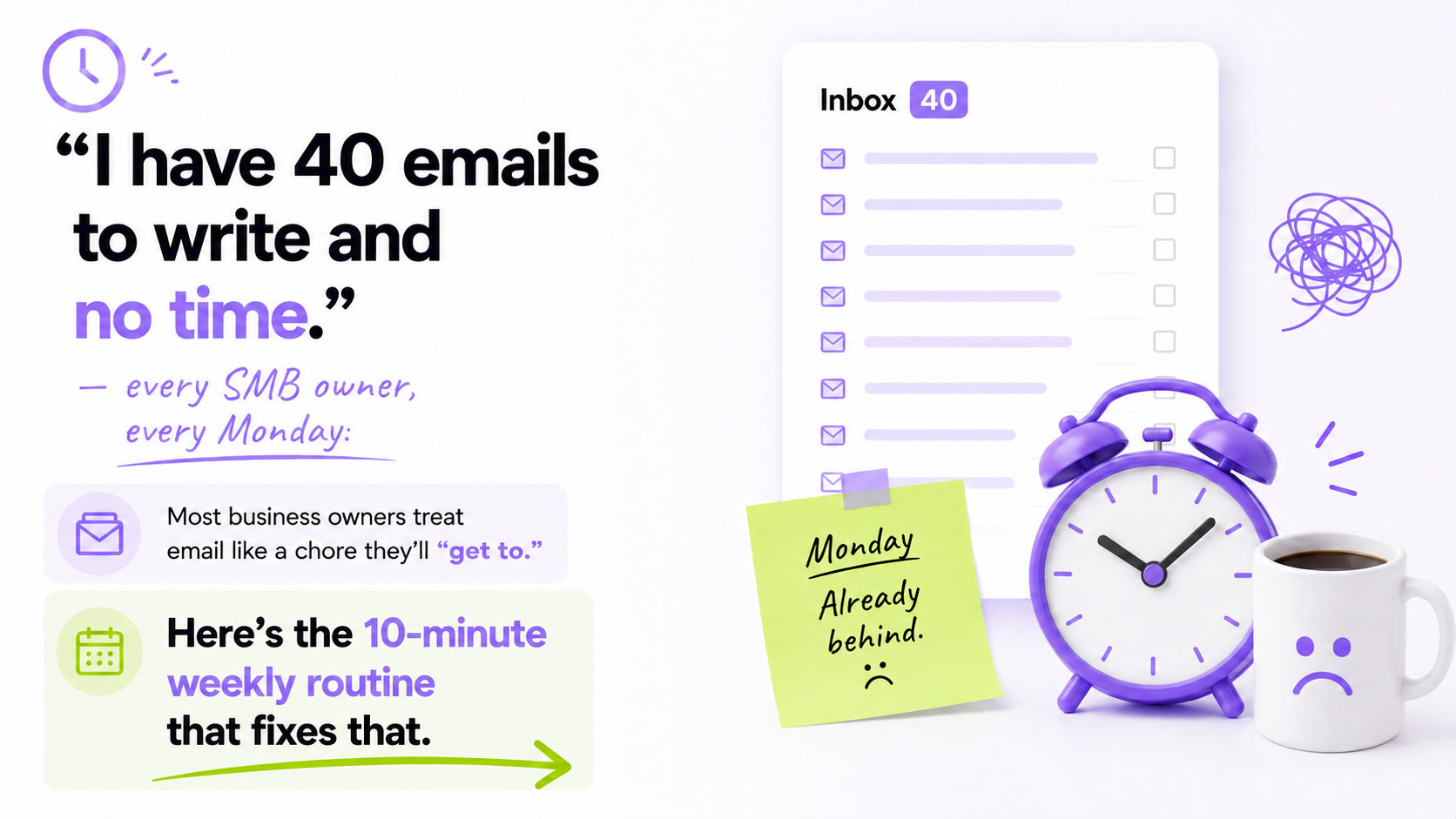
“I have 40 emails to write and no time.”
That is how email marketing can feel when you run a small business. It becomes one more enormous task squeezed between helping customers, paying invoices, updating your website, and trying to remember where you left your coffee.
But you probably do not need to write 40 emails.
You need to send one useful email at a time. With a simple routine and a little help from AI you can prepare your next campaign in about 10 minutes.
Why does email marketing feel overwhelming for small businesses?
Small business owners often treat every email campaign as a completely new project. They start with a blank page, try to find several things to say, rewrite the subject line repeatedly, and then worry about links, formatting, recipients, and deliverability.
That is a lot of small decisions for one email.
A repeatable process removes most of them. Instead of asking, “How do I do all my email marketing?” ask, “What useful email can I prepare this week?”
The following routine divides that job into five short steps.
What is the 10-minute email marketing routine?
The routine looks like this:
- Minutes 1–2: Review the last campaign.
- Minutes 3–4: Choose one useful topic.
- Minutes 5–6: Ask AI to create a first draft.
- Minutes 7–8: Rewrite the draft in your own voice.
- Minutes 9–10: Check and schedule the email.
You are not trying to build an entire email strategy in 10 minutes. You are creating enough momentum to send one relevant message instead of postponing email marketing for another week.
How should you review your last email campaign?
Spend two minutes looking for one useful lesson, not every possible insight.
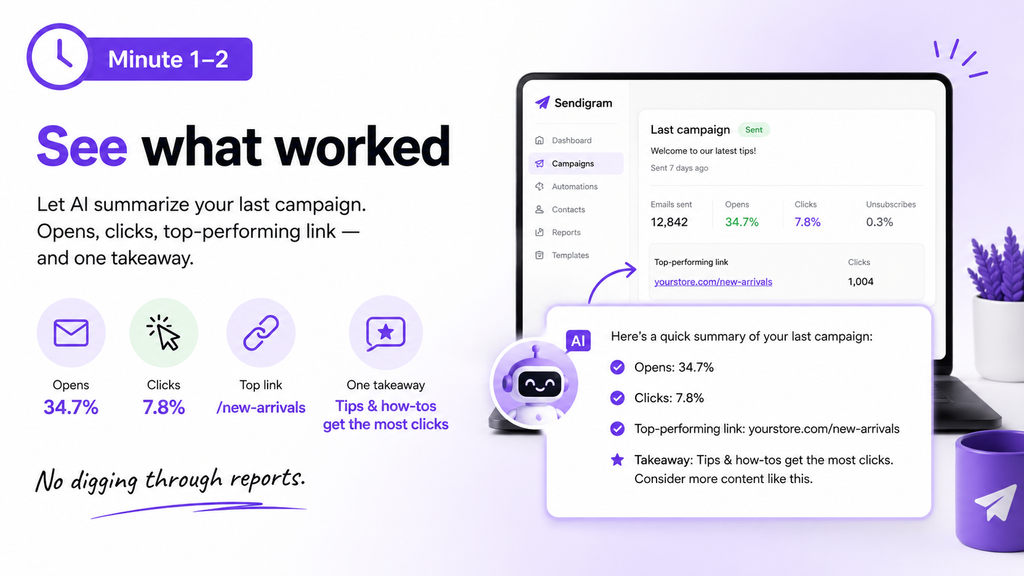
Check a few basic results from your previous campaign:
- Click rate
- The link that received the most clicks
- Replies
- Unsubscribes
- Sales, bookings, downloads, or another conversion connected to the email
You can also look at the open rate, but treat it as a directional signal rather than a perfect measurement. Privacy features and image-loading behavior can make opens less reliable than clicks, replies, and conversions.
Then ask: What seemed to interest people most?
If one link received most of the clicks, your audience may want more advice, products, or information on that subject. If people opened but did not click, the email may have needed a clearer offer or next step. If readers replied, their questions may give you the topic for your next campaign.
Take away one lesson and move on. This is a quick check, not an archaeological dig through your reports.
What should a small business email its customers about?
Choose one subject that is useful to your customers right now.
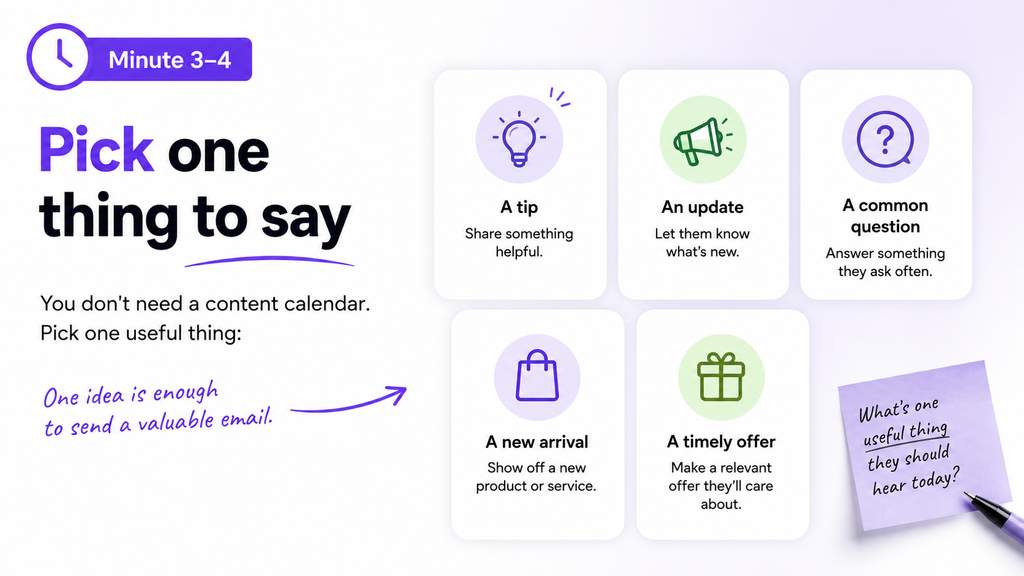
Your email could contain:
- A practical tip
- An answer to a common customer question
- A short business or product update
- A new product or service
- A customer story or example
- A timely and genuinely relevant offer
One clear idea is usually stronger than five unrelated announcements squeezed into the same email.
If you are stuck, ask yourself one of these questions:
- What do customers frequently ask before buying?
- What small problem can I help them solve today?
- What received the most interest in my previous email?
- What is new, useful, or time-sensitive this week?
You do not need a complicated content calendar to answer one of those.
How can AI help you write a marketing email?
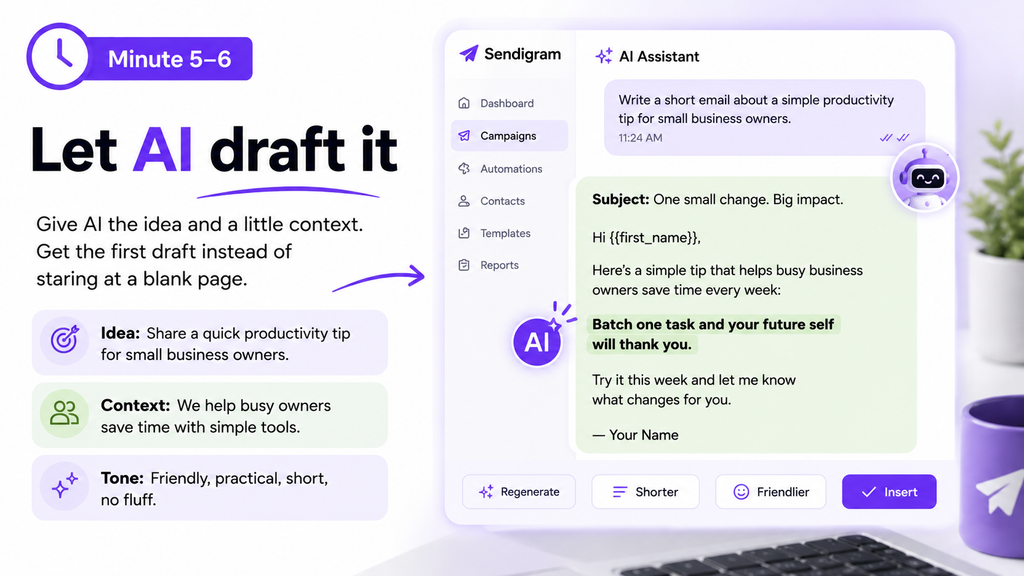
AI can quickly turn your idea into a first draft when you give it a clear topic, audience, goal, and tone.
Avoid prompts such as “Write a marketing email.” The result will probably sound like it could have come from any business and it may contain enough enthusiasm to power a small city.
Instead, include four details:
- Topic: What should the email say?
- Audience: Who will receive it?
- Goal: What should readers understand or do?
- Tone: How should the email sound?
For example:
Write a short email sharing one simple productivity tip with busy small business owners. The goal is to help them save time and encourage them to try the tip this week. Keep the tone friendly, practical, and concise. Avoid hype and complicated language.
Use the result as a starting point, not a finished campaign. AI handles the awkward blank-page stage; you decide what is accurate, useful, and appropriate for your customers.
How do you make an AI-written email sound human?
Read the draft aloud and replace anything you would not naturally say to a customer.
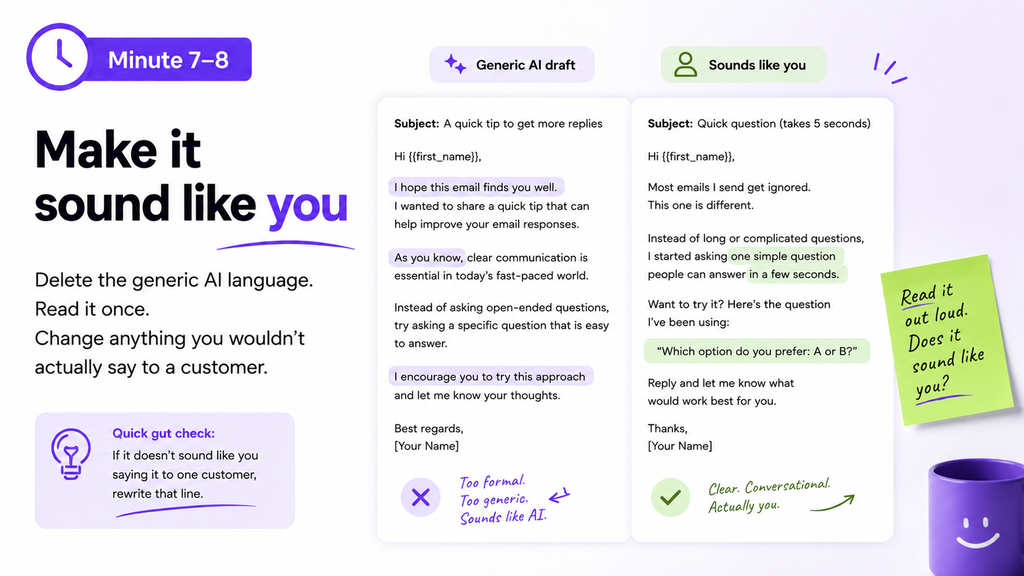
Remove language that feels too polished, vague, or formal. Be especially suspicious of phrases such as “in today’s fast-paced world,” “unlock your potential,” and “we are thrilled to announce.” They are not always wrong, but they tend to make different businesses sound exactly the same.
Make the draft more specific instead:
- Replace broad claims with a concrete benefit.
- Use short sentences where they sound more natural.
- Add a real example or useful detail.
- Ask a simple question readers can answer.
- Keep only one clear call to action.
Your email does not need to sound perfect. It needs to sound like it came from a real person who understands why the reader might care.
What should you check before sending a marketing email?
Before sending, verify the audience, sender details, links, mobile layout, message, and next step.
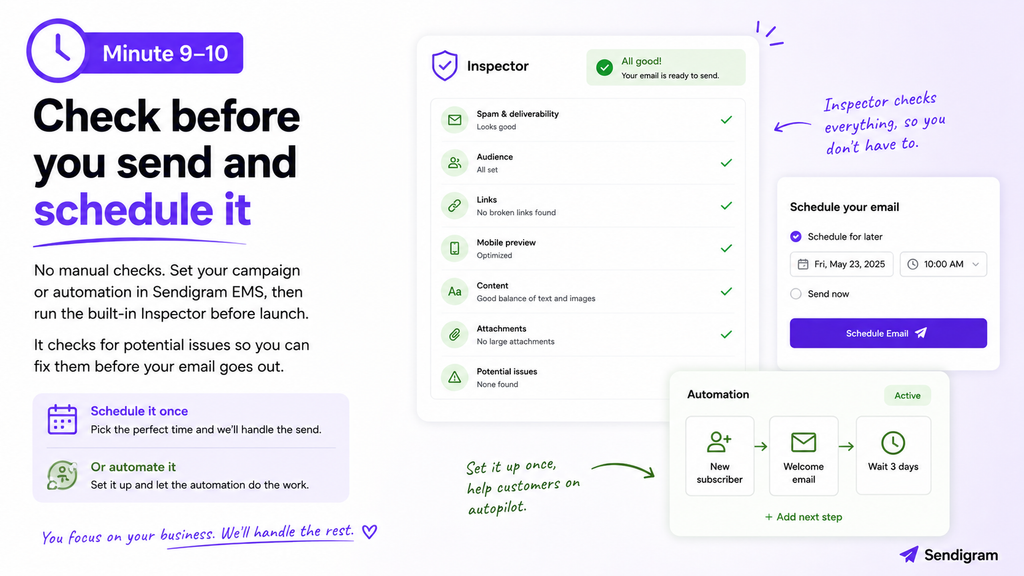
Use this quick pre-send checklist:
- Is the email going to the correct group or segment?
- Are the sender name, sender address, and reply-to address correct?
- Do the subject line and preheader work together?
- Do all the links lead to the correct pages?
- Does the email look good on a phone?
- Is the main message easy to understand?
- Is there one clear next step?
- Is the unsubscribe option easy to find?
- Are there any obvious spam or deliverability problems?
If your email marketing platform includes an automatic pre-send checker, let it handle the repetitive checks. Sendigram’s built-in Inspector, for example, reviews the campaign before launch and flags potential issues so you can correct them before the email goes out.
Finally, send a test email if necessary and schedule the campaign. If the message should be triggered by a customer action, such as subscribing, making a purchase, or becoming inactive—add it to an automation instead.
Set it up once, and let the system remember it for you.
Does a small business need to send marketing emails every week?
No. Consistency matters more than forcing an email into every Friday afternoon.
A weekly routine can still be useful if you send twice a month. Use the time to review results, collect ideas, or prepare the next campaign in advance. Choose a schedule you can maintain without sending emails simply because the calendar told you to.
The right frequency depends on what you sell, how often customers want to hear from you, and whether each message provides a useful reason to open it.
A simple email marketing process is easier to repeat
Small business email marketing becomes overwhelming when every campaign feels like a giant creative project. It becomes manageable when you turn it into a short routine:
- Review one result.
- Choose one useful idea.
- Ask AI for a first draft.
- Rewrite it in your own voice.
- Check it and schedule it.
Ten focused minutes will not build your entire email marketing strategy. But they can help you send one relevant email this week instead of waiting for the mythical quiet Monday when you finally have several free hours.
That Monday is probably not coming. Your next email still can.
Want to make the routine even simpler? Create a free Sendigram account to create, check, schedule, and automate your emails in one place.
Frequently asked questions about small business email marketing
How often should a small business send marketing emails?
Many small businesses start with one or two useful emails per month and adjust based on customer expectations, engagement, and available content. A sustainable schedule is better than sending frequently for a few weeks and then disappearing.
Can a small business use AI to write marketing emails?
Yes. AI can create outlines, subject-line ideas, and first drafts. Give it information about your audience, goal, topic, and tone, then review the result for accuracy and rewrite it in your own voice before sending.
What email marketing metrics should a small business track?
Start with clicks, conversions, replies, unsubscribes, and the links that receive the most attention. Open rates can provide context, but they should not be treated as a perfectly accurate measure of reader interest.
What can I email customers when I have nothing new to sell?
Answer a common question, share a useful tip, explain how to get more value from a product, tell a brief customer story, or highlight an older resource that is still relevant. Every email does not need to contain a promotion.
Do I need a content calendar for email marketing?
Not necessarily. A simple list of customer questions, seasonal moments, useful tips, product updates, and offers may be enough. A content calendar becomes helpful when several people contribute or when you plan campaigns across multiple channels.




 Your Privacy Choices
