
- Home
- Email Tips and Tricks
- How Long Should a Welcome Emai ...


A welcome email sequence should be long enough to help a new subscriber understand your business, experience the value of your product and take the next logical step—but not so long that you begin repeating yourself.
For a simple, low-cost product, a focused 5–7-day welcome sequence may be sufficient. A more complex service, software product or educational offer may need a 30-day onboarding journey.
The right length depends on the customer journey, not an arbitrary number of days.
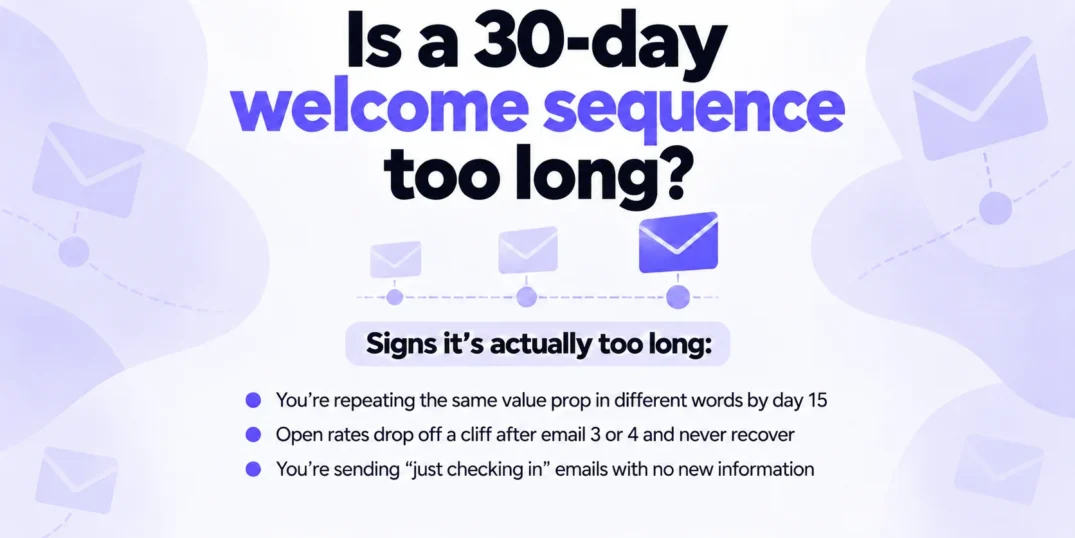
Is a 30-day welcome email sequence too long?
Not necessarily.
Thirty days is too long when you spend the second half of the sequence repeating the same benefits in slightly different words. It can be completely reasonable when each message helps the subscriber achieve something new.
A 30-day sequence may work well when your product:
- Has a genuine learning curve
- Includes several important features
- Requires setup or onboarding
- Serves multiple use cases
- Involves a higher-consideration purchase
- Benefits from gradual education
- Requires time before the customer experiences its full value
The sequence does not need to contain 30 emails. It might include five, seven or ten carefully timed messages distributed across the month.
The objective is not to occupy every day. It is to guide the subscriber from signup to activation.
Signs your welcome sequence is too long
The number of days alone does not tell you whether a sequence is excessive. Look for signs that the content has run out of work to do.
You are repeating the same value proposition
If every email says that your product is simple, powerful or time-saving without adding new evidence, the sequence is probably becoming repetitive.
Each message should answer a different question or help the subscriber complete a different step.
Engagement drops and never recovers
A decline after the first welcome email is normal. The first email often receives the most attention because the signup is still fresh.
The concern is a sharp, sustained drop after email three or four, especially if later emails generate almost no clicks, replies, product activity or conversions.
Do not assess this using open rates alone. Privacy features and image blocking can make opens unreliable. Review clicks, replies, account activity, bookings, purchases and other meaningful actions.
You are sending “just checking in” emails
A follow-up needs a reason to exist.
If a message contains no useful information, relevant reminder or clear next step, it is not nurturing the subscriber. It is simply filling space in the schedule.
Subscribers receive unrelated promotions before onboarding ends
Long welcome automations can overlap with regular newsletters, promotions and other automated journeys.
A subscriber who expected one useful introduction may suddenly receive several emails in the same week. Review your exclusions, frequency rules and automation overlaps.
The sequence delays the obvious next step
Do not force people through weeks of education before showing them how to buy, book, start or upgrade.
Some subscribers are ready immediately. Give them a clear next step from the beginning, even if you continue supporting those who need more time.
When a 30-day welcome journey makes sense
Longer onboarding works best when the subscriber must learn something before receiving full value.
Imagine that you sell a software platform, professional service or educational product. A new customer may need to understand several features, configure an account and see practical examples before the product becomes useful.
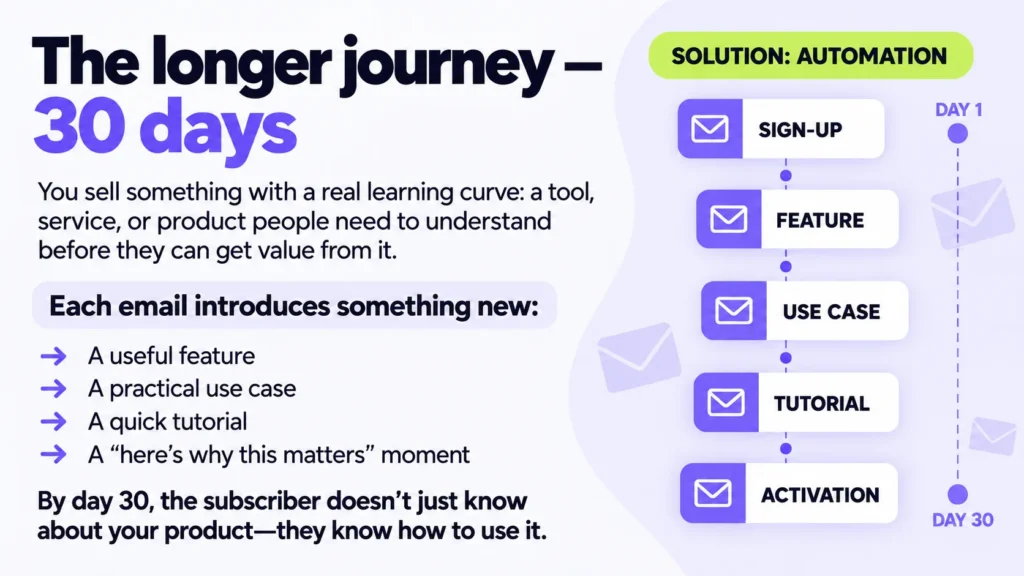
A 30-day journey could include:
- Welcome and orientation
Confirm the signup, explain what happens next and give the subscriber one simple first action. - Most useful feature
Introduce the capability that helps new users reach value fastest. - Practical use case
Show how a real customer or business might use the feature. - Quick tutorial
Help the subscriber complete a small task without requiring a lengthy manual. - Common obstacle
Address the issue that most often prevents people from progressing. - Secondary feature or workflow
Introduce another capability only after the first one makes sense. - Activation step
Ask the subscriber to create, publish, book, connect or complete something meaningful. - Next-stage recommendation
Direct active users toward a more advanced workflow and inactive users toward extra help.
Every email moves the relationship forward. By the end, the subscriber does not merely know what the product is—they understand how to use it.
When a 5–7-day welcome sequence is enough
A shorter sequence usually works better when the offer is easy to understand and the buying decision requires little education.
Consider a small online shop selling a $20 candle. Most subscribers do not need a month-long lesson about candles before deciding whether to buy one.
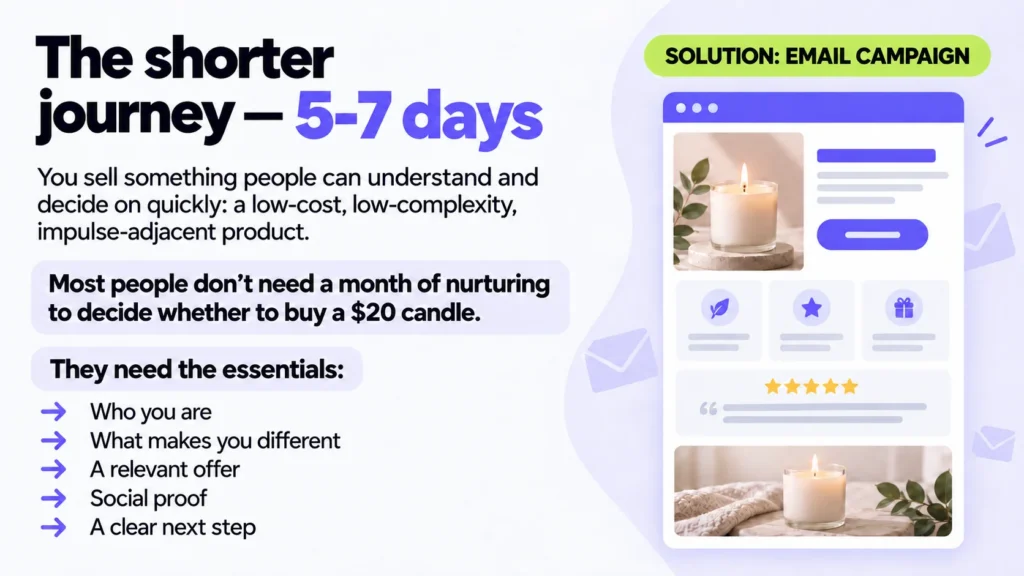
They probably need:
- A clear introduction to the business
- The reason the product is different
- A relevant offer
- Social proof
- Answers to likely objections
- One obvious next step
A compact sequence could look like this:
Day 1: Welcome and introduction
Thank the subscriber, set expectations and explain what your business offers.
Day 2: What makes the product different
Highlight the most relevant differentiator instead of listing every available feature.
Day 3: Social proof
Use a customer review, result or short story to reduce uncertainty.
Day 5: Relevant offer
Present an incentive, popular product or recommendation that fits the subscriber’s reason for joining.
Day 7: Final reminder or next step
Give the subscriber a clear choice: shop, book, reply, explore a category or update their preferences.
Once the subscriber has enough information to decide, extending the sequence may only create repetition.
Stop choosing welcome-sequence length by day count
A better method is to map what the subscriber needs to know or do.
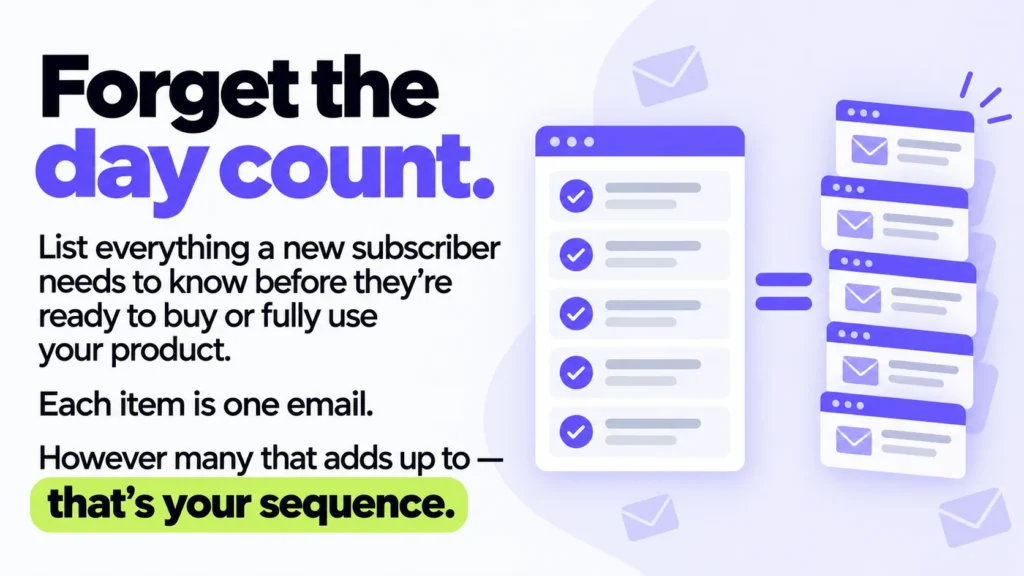
Start with one question:
What must a new subscriber understand before they are ready to buy or receive meaningful value from the product?
Create a list of those requirements. For example:
- Understand who the business serves
- Recognize the main problem being solved
- Learn the primary feature
- See a practical example
- Trust the business
- Resolve a common objection
- Complete the first meaningful action
- Choose the next step
Each essential item can become one email.
If the list produces five useful messages, you have a five-email sequence. If it produces nine genuinely different messages, you may need nine.
The sequence is complete when the journey is complete—not when the calendar reaches a predetermined number.
Should you use an automation or a regular campaign?
The length of the sequence does not decide this. The timing does.
Use an automation when every subscriber should receive messages relative to an individual trigger, such as:
- Joining the list
- Creating an account
- Downloading a resource
- Making a first purchase
- Starting a trial
Automation ensures that each person begins with email one, regardless of when they sign up.
Use a regular email campaign when everyone should receive the same message at the same time, such as:
- A seasonal promotion
- A product announcement
- A limited-time sale
- A scheduled newsletter
- An event reminder
A five-day welcome sequence may still be automated. A 30-day promotional calendar may still consist of regular campaigns. Choose based on the subscriber’s trigger, not the number of days.
How to improve an existing welcome sequence
Review every email and ask:
- Does this message introduce something new?
- Does it help the subscriber complete a step?
- Is its call to action clear?
- Could it be combined with another email?
- Would removing it create a meaningful gap?
- Is it overlapping with another campaign or automation?
- Does the subscriber have an easy way to change preferences or unsubscribe?
If removing an email changes nothing, that email probably does not need to exist.
You can also segment the sequence according to subscriber behavior. People who activate quickly may skip introductory messages, while inactive subscribers may receive additional guidance.
The right welcome sequence is as long as the customer journey
A long sequence is not automatically better nurturing. A short sequence is not automatically more respectful.
The best welcome journey contains enough useful messages to move a subscriber from interest to understanding and from understanding to action.
For a straightforward product, that may take five days.
For a complex tool or service, it may take a month.
Forget the ideal day count. List what your new subscriber genuinely needs, give each email a clear job and stop when the journey is complete.
Frequently asked questions
How many emails should a welcome sequence contain?
Many welcome sequences contain between three and seven emails, but there is no universal ideal. The sequence should include one useful message for each important step in the subscriber’s early journey.
Is a 30-day welcome sequence too long?
It is not too long if the messages introduce new information and guide subscribers toward activation. It is too long if later emails become repetitive or unnecessary.
How often should welcome emails be sent?
Early messages may be sent closer together while interest is fresh. Later educational emails can be spaced farther apart. Frequency should also account for newsletters and other automations the subscriber may receive.
Should a welcome sequence be automated?
Usually, yes. If the journey begins when an individual subscribes, downloads something, makes a purchase or starts a trial, automation delivers the sequence relative to that event.
What is the difference between a welcome sequence and an email campaign?
A welcome sequence is usually triggered by an individual subscriber’s action. A campaign is generally scheduled for an audience at a particular time.


 Your Privacy Choices
